
UD Prepreg and UHMWPE Impregnation in Laminating Lines: A Technical Parameter Guide
When a ballistic composite producer evaluates a UD prepreg or UHMWPE impregnation line, the parameters on the spec sheet—material width, roll surface length, adhesive type, and connected power—are often read as independent numbers. In practice, they are interdependent. A 1,800 mm roll face paired with a 1,650 mm maximum material width on the KT-YJ-1800 and KT-LH-1800 platforms illustrates a deliberate design margin. The choice of water-based adhesive affects not only the coating station but also the drying, web handling, and energy profile of the entire line. And the power rating—90 kW for the KT-YJ-1800 and approximately 95 kW for UD crossply work on the KT-LH-1800—reflects the mechanical and thermal load created by those upstream decisions.
This guide explains how those parameters relate, why the roll surface exceeds material width, and what buyers producing vests, helmets, and ballistic plates should verify before committing to a line configuration. It uses the KT-YJ-1800 and KT-LH-1800 from JIANGSU KUNTAI MACHINERY CO.,LTD—a manufacturer of laminating, impregnation, and cutting machinery for technical textiles and composites—as grounded examples.
Problem Definition: Why Parameter Interdependence Matters
UD prepreg and UHMWPE impregnation share a common objective: produce a consistent, defect-controlled composite sheet from aligned high-performance fibers and a resin or adhesive system. The difference lies in the material and the downstream application. UD prepreg typically refers to unidirectional fiber reinforcement that has been impregnated with a resin matrix, then partially cured or staged for later lamination. UHMWPE impregnation involves the wetting and coating of ultra-high-molecular-weight polyethylene fibers or fabrics, often for ballistic applications where fiber alignment and adhesive distribution directly affect energy absorption.
In both cases, the equipment must control four variables simultaneously: how wide the material can run, how evenly the adhesive is applied across that width, how much thermal energy is required to dry or cure the adhesive, and how much mechanical tension the line can maintain without distorting fiber alignment. Buyers who evaluate one parameter without the others risk specifying a line that cannot reach its rated width, or that consumes more energy than planned.
Industry Background: Ballistic Composites and Line Design
Ballistic composite manufacturing has expanded from a niche defense activity to a broader industrial segment. The same UD prepreg and UHMWPE impregnation equipment used for vests and helmets is also used for vehicle armor panels, protective plates, and industrial composite components. As production volumes grow, line designers face pressure to increase width utilization—running wider material reduces edge trim waste and improves throughput per meter of line.
At the same time, the adhesive systems used in ballistic composites continue to evolve. Water-based adhesives offer environmental and workplace safety advantages compared with solvent-based systems, but they impose specific drying requirements that affect line length, temperature control, and energy consumption. Both the KT-YJ-1800 and KT-LH-1800 use water-based adhesive, a configuration that shapes their parameter profile in ways buyers should understand.
Detailed Solution: How the KT-YJ-1800 and KT-LH-1800 Configure These Parameters
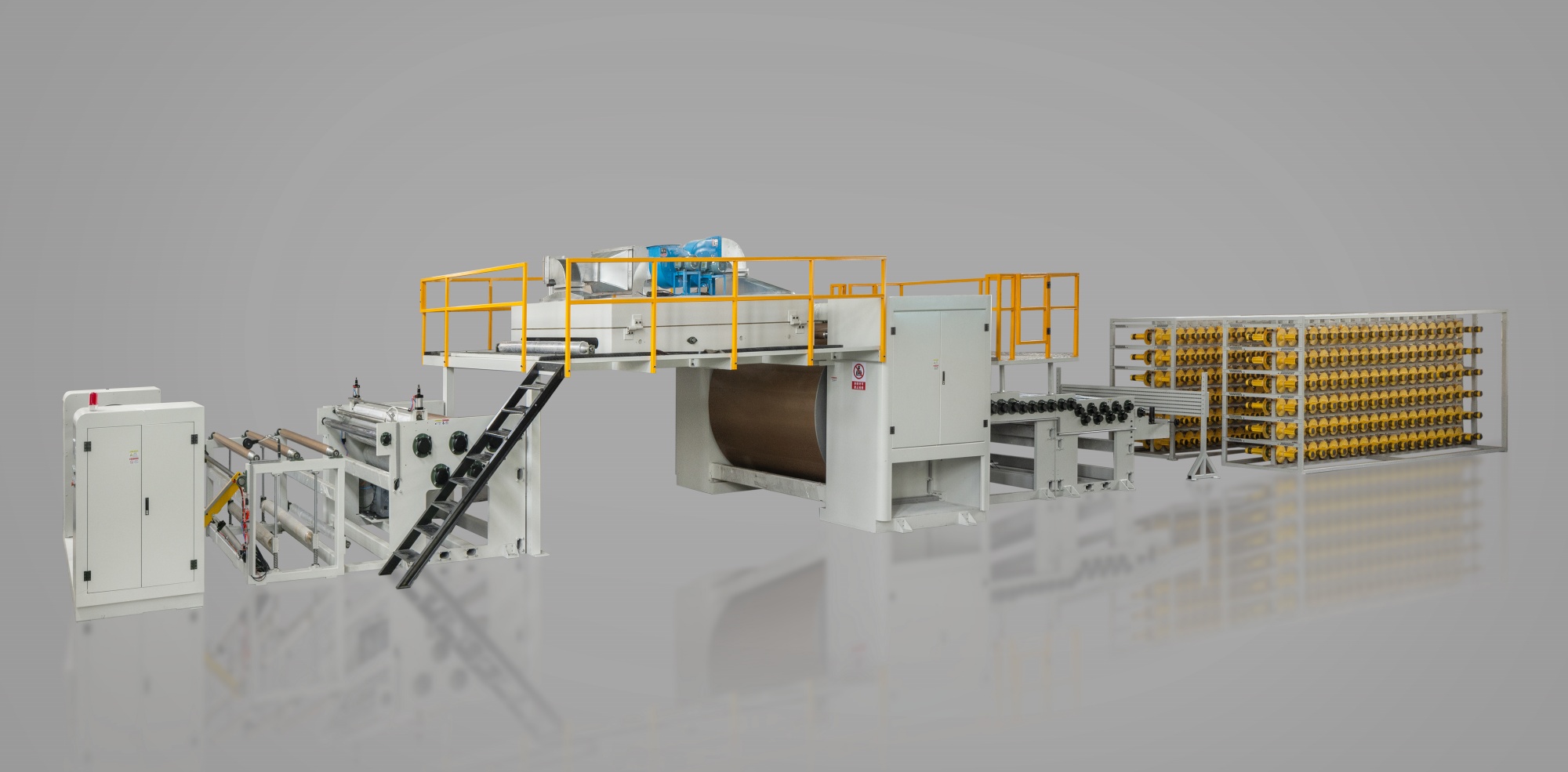
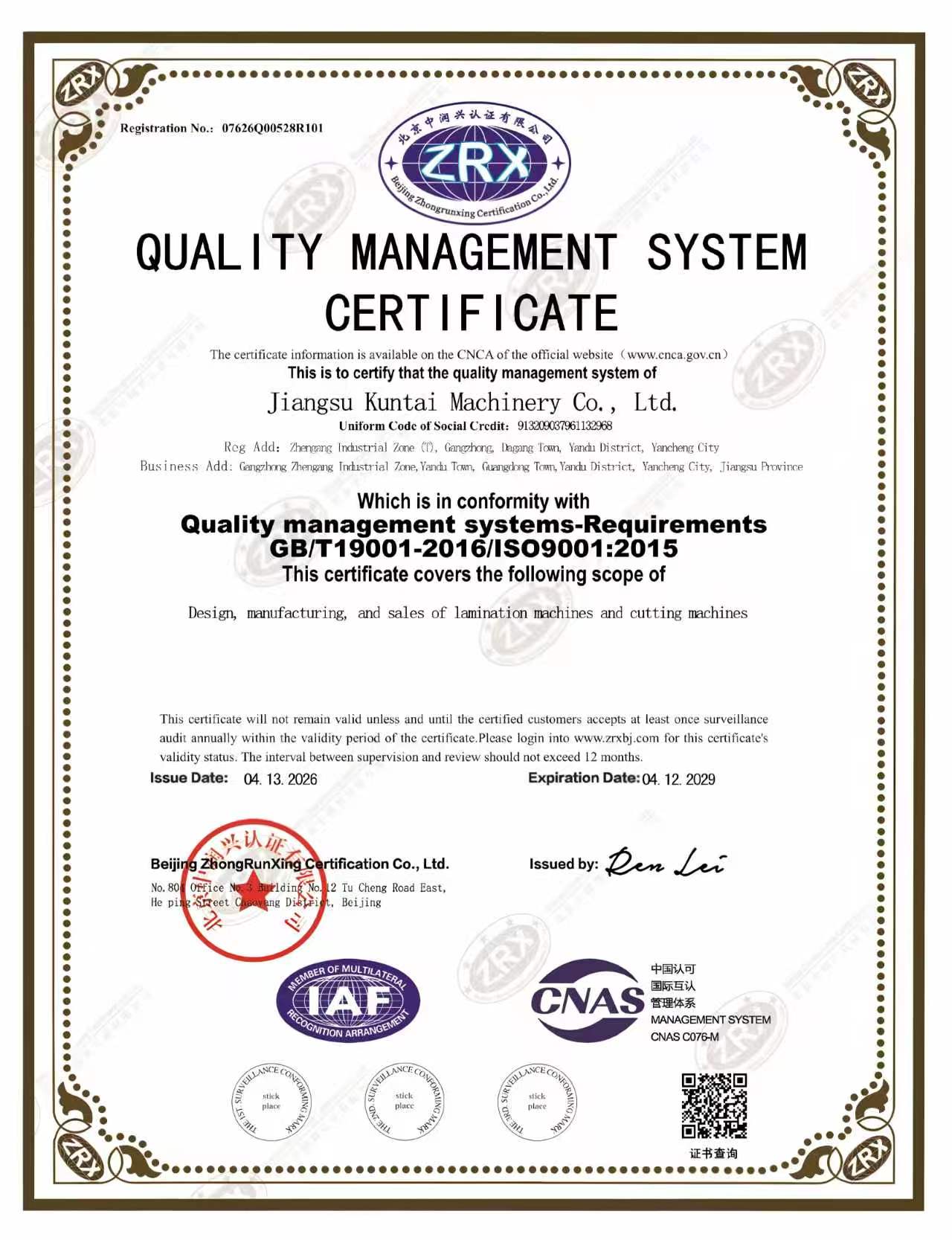
The KT-YJ-1800 and KT-LH-1800 platforms from JIANGSU KUNTAI MACHINERY CO.,LTD illustrate how the four parameters interact in a production configuration. KUNTAI designs and manufactures laminating, impregnation, and cutting machinery for technical textiles and composites, with production based in Zhengang Industrial Park, Yancheng City, Jiangsu, China. The company holds ISO 9001 certification (certificate number 07626Q00528R101, valid from 2026-04-13 to 2029-04-12) for the design, manufacturing, and sales of lamination machines and cutting machines, and CE certification under the Machinery Directive (certificate number NO.3N221214.JKMSU84, valid from 2022-12-14 to 2027-12-13).
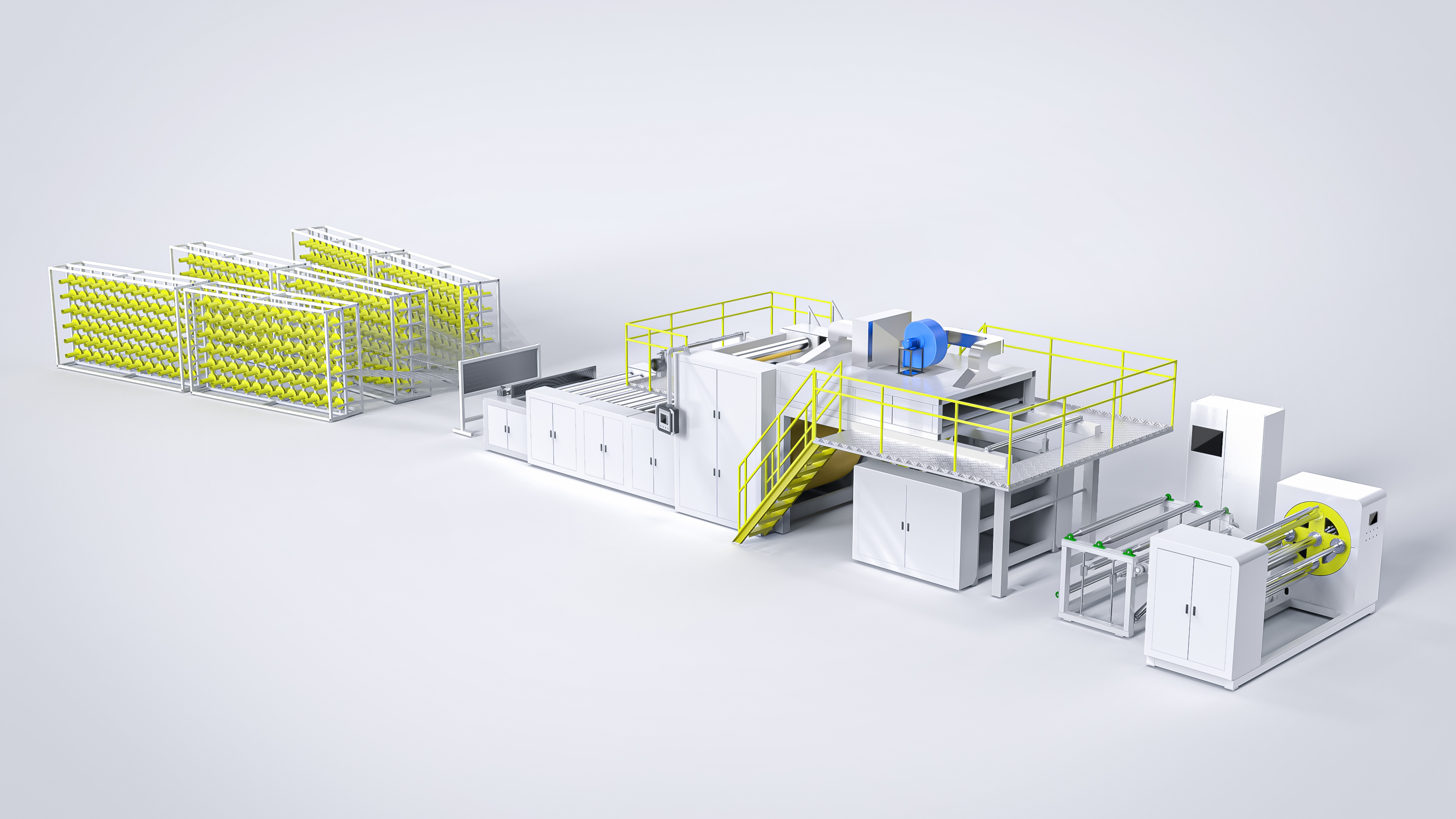
The KT-YJ-1800 is a UHMWPE impregnation machine rated for material widths up to 1,650 mm, with a roll surface length of 1,800 mm. It uses water-based adhesive and accommodates 1,080 yarn bobbins. Its connected power rating is 90 kW. The KT-LH-1800 serves UD crossply and prepreg impregnation applications, with the same 1,650 mm material width limit and 1,800 mm roll surface, also using water-based adhesive, with a power requirement of approximately 95 kW for UD crossply operation.
These figures are not arbitrary. Each addresses a specific production requirement, and understanding why they are set as they are helps buyers evaluate whether a given line matches their application.
Step-by-Step Breakdown: Parameter Relationships
Step 1: Material Width and the Roll Surface Margin
The 150 mm difference between the 1,650 mm maximum material width and the 1,800 mm roll surface is a design margin with several functions. First, it provides edge control. When a web runs at its maximum rated width, lateral drift—caused by tension variation, roller alignment, or material thickness inconsistency—can push the edge beyond the intended path. A wider roll surface gives the web room to recover without the edge running off the roller, which is critical when processing UHMWPE fibers that can fray if pinched or misaligned.
Second, the margin supports thermal uniformity. The roll surface is a heat-transfer component in many impregnation configurations. A roll that extends beyond the material edge maintains a more uniform temperature profile across the working width, because the edges of the material are not exposed to a sudden temperature drop at the roll boundary. This matters for water-based adhesives, which require controlled drying to avoid skinning, blistering, or incomplete coalescence.
Third, the margin simplifies changeover. A producer running narrower material—say 1,200 mm—on a 1,800 mm roll does not need to change the roll to switch between product widths. The extra surface accommodates multiple product formats without mechanical modification, a practical advantage for facilities producing vests, helmets, and plates on the same line.
The buyer's verification task here is straightforward but often neglected: confirm that the rated material width and roll surface dimensions are measured under production conditions, not just in a static drawing. Ask for the acceptance test record showing the line running at or near maximum width, and inspect the edge quality of the output.
Step 2: Adhesive Method and Line Configuration
Water-based adhesives change the line architecture in ways that affect every downstream parameter. Unlike hot-melt systems that solidify on cooling or PUR systems that cure through moisture reaction over 24 to 72 hours, water-based adhesives require the line to remove water through evaporation. That means the line needs drying capacity—heated rolls, forced-air ovens, or a combination—and the drying section must be long enough and hot enough to bring the adhesive to the required solids content without degrading the fiber or the adhesive itself.
This is why the power rating on a water-based line cannot be compared directly with a hot-melt line of similar width. The 90 kW on the KT-YJ-1800 includes the energy needed for water evaporation, not just mechanical drive and roller heating. The approximately 95 kW on the KT-LH-1800 for UD crossply work reflects the additional thermal load of a crossply configuration, where two material streams may need independent temperature control before combination.
Step 3: Power Requirements and Electrical Planning
The 90 kW and 95 kW figures are connected load ratings, not average consumption. Buyers planning a new line should verify three things: the facility's available power capacity, the voltage and phase configuration (KUNTAI offers voltage customization as part of its OEM service), and the actual power draw profile during production. A line rated at 90 kW may draw less during steady-state operation but require the full capacity during startup heating and high-speed drying.
For producers in regions with unstable grid supply, the power rating also informs decisions about backup generation or voltage stabilization. KUNTAI's customization options include voltage adaptation, which allows the line to be matched to local supply conditions rather than requiring the buyer to upgrade the facility's electrical infrastructure.
Step 4: Yarn Bobbin Capacity and Creel Planning
The KT-YJ-1800 accommodates 1,080 yarn bobbins. This figure determines the creel size and the maximum continuous run length before a bobbin change is required. A producer running wide material at high speed will consume bobbins faster than a producer running narrow material at low speed. The 1,080-bobbin capacity is a design choice that balances creel footprint against run time; buyers should calculate their expected consumption rate and verify that the creel capacity matches their production schedule, or plan for a bobbin-change procedure that does not interrupt the line.
Use Cases: Vest, Helmet, and Plate Production
Ballistic Vests
Vest panels typically use multiple layers of UD prepreg or UHMWPE impregnated fabric, cut to shape and assembled. The material width requirement for vest production is usually narrower than the line's maximum, because vest panels are cut from wider sheet stock. A 1,650 mm width capability allows the producer to run multiple panel widths across the web, improving material utilization. The 1,800 mm roll surface provides the edge margin needed when running at or near maximum width.
Helmets
Helmet shells require prepreg with consistent fiber alignment and controlled adhesive distribution, because the forming process reshapes the flat sheet into a curved shell. Any width-direction variation in adhesive content or fiber spacing can cause wrinkles or resin-rich zones during forming. Water-based adhesive systems, when properly dried, provide a uniform tack that holds the fibers in place during cutting and layup. The drying control discussed in Step 2 is therefore directly relevant to helmet yield.
Ballistic Plates
Plates are typically thicker and stiffer than vest panels, requiring multiple prepreg layers pressed together. The line's ability to produce consistent areal weight across the full width is critical, because plate performance depends on uniform density. A line that runs at 1,650 mm but produces edge-heavy or edge-light material will generate plates with inconsistent ballistic performance. The roll surface margin helps maintain thermal and pressure uniformity across the width, but buyers should verify areal weight distribution with a sample test.
KUNTAI reports a protective products customer operating 50 units across Turkey, the Czech Republic, India, and Russia for three years in vest, helmet, and plate production, with stable operation and low maintenance as reported outcomes. This reference indicates application experience but does not by itself establish performance for any specific buyer's material system or production conditions.
Comparison Table: KT-YJ-1800 vs. KT-LH-1800 on Shared Parameters
| Parameter | KT-YJ-1800 | KT-LH-1800 |
|---|---|---|
| Material width | ≤1,650 mm | ≤1,650 mm |
| Roll surface length | 1,800 mm | 1,800 mm |
| Adhesive type | Water-based | Water-based |
| Connected power | 90 kW | Approx. 95 kW (UD crossply) |
| Yarn bobbins | 1,080 | Not specified in supplied parameters |
The table shows the shared width and roll surface platform, the common water-based adhesive approach, and the power difference that reflects the additional thermal load of UD crossply operation on the KT-LH-1800.
Frequently Asked Questions
Conclusion: From Parameters to Production Verification
The parameters on a UD prepreg or UHMWPE impregnation line are not independent. Material width, roll surface, adhesive method, and power rating form a linked system, and changing one affects the others. The KT-YJ-1800 and KT-LH-1800 illustrate this relationship: a 1,800 mm roll surface paired with a 1,650 mm width limit provides edge control and thermal margin; water-based adhesive adds drying load and shapes the power profile; and the 90 kW or approximately 95 kW rating reflects the combined mechanical and thermal demand of the configured line.
For buyers producing vests, helmets, and ballistic plates, the verification task is to confirm that these parameters hold under production conditions—not just on the spec sheet. That means asking for acceptance test records at or near maximum width, confirming adhesive solids content after drying, checking power supply compatibility, and matching yarn bobbin capacity to the production schedule. KUNTAI's OEM and customization options, pre-shipment testing, and ISO 9001 and CE certifications provide a starting framework for that verification. The company's reported experience with a protective products customer—50 units operating for three years across vests, helmets, and plates—offers a reference point, though each buyer's application will have its own requirements.
Planning a UD prepreg or UHMWPE impregnation line for ballistic composites?
Download the KUNTAI company profile (PDF) for the full machinery portfolio, or contact the technical team to discuss material width, adhesive configuration, and power planning for your specific application.
Have Questions or Need More Details?
Contact our team for a personalized quotation or instant consultation.
Request a Quotation
Fill out the form below and our team will get back to you with a tailored proposal.
WhatsApp Direct Chat
Prefer to chat in real-time? Message us on WhatsApp for instant assistance & quick answers.
- Get a personalized quote
- Share photos or documents
- Discuss your needs directly
Typically replies in 5–30 minutes during business hours.