
Machine Construction Standards for Safety Footwear Laminating Machines: A Compliance Guide
A safety footwear laminating machine is only as compliant as the documents behind its build. For a buyer in the evaluation stage, the decisive evidence is not a brochure image but four verifiable items: the frame material grade, the thermal and adhesive system configuration, the identity of the electrical components inside the cabinet, and a certificate whose scope names the exact machine model.
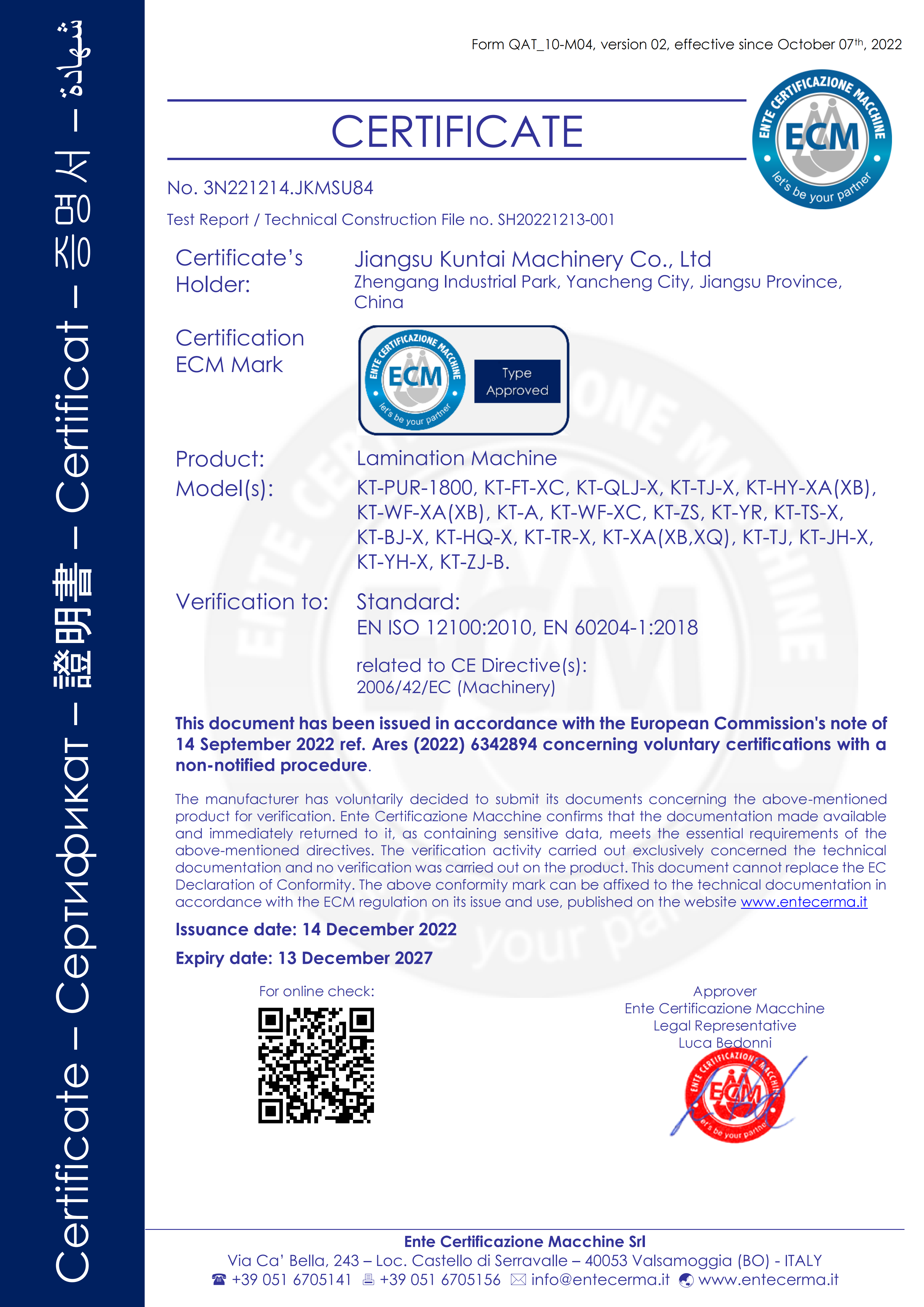
JIANGSU KUNTAI MACHINERY CO.,LTD holds an ECM Type Approved CE certificate (NO.3N221214.JKMSU84) issued under Directive 2006/42/EC, with the KT-PUR-1800 named inside the certificate scope.
The KT-PUR-1800 hot melt coating laminating machine, built by JIANGSU KUNTAI MACHINERY CO.,LTD (KUNTAI), shows how that evidence set can be assembled for a footwear production line: carbon steel or SS304 construction, Schneider electrics, an Inovance inverter, and a CE certificate whose scope names the model. This guide sets out the construction standards that matter in safety shoe manufacturing and shows how to verify each one before a purchase order is issued.
Why Machine Construction Is the First Compliance Question in Safety Footwear Lamination
Safety footwear is a bonded composite. Upper fabrics, linings, foam and reinforcement layers are combined into one material stack, and the bond quality depends on three variables that are set by the machine itself: how evenly adhesive is deposited across the width, how tightly roller temperature is held during the pass, and how consistently pressure is repeated from the first metre of the run to the last.
None of those three variables can be judged from a product photograph. Frame plate thickness, weld quality, corrosion protection, cable routing and cabinet layout are invisible on a specification sheet, yet they determine whether a machine can be maintained over a ten-year horizon and whether it can be accepted into a regulated production environment.
Three construction items carry the highest evaluation risk:
- Frame material grade. Carbon steel and SS304 behave differently over years of thermal cycling and adhesive exposure. The grade should appear in the technical agreement, not only in a conversation.
- Electrical component identity. Contactors, breakers, terminals and inverters determine spare-part availability, panel safety review and repair speed in the buyer's own country.
- Certification scope. A CE certificate that covers a machine family but does not name your model creates a documentation gap during import clearance, insurance review and customer audits.
Industry Background: Demand Is Rising, and So Are Documentation Expectations
The equipment category is expanding. Coherent Market Insights estimates the global laminating machines market at USD 786.5 million in 2026, projected to reach USD 1,356.7 million by 2033. On the consumable side, Dataintelo projects the PUR hot melt adhesives market to grow at a CAGR of 7.2% through 2034, reaching USD 7.1 billion. Fortune Business Insights reports that Asia-Pacific held a 72.70% share of the textile machinery market in 2025, led by automation growth in China.
Those numbers matter to a compliance discussion for one practical reason: as hot melt and PUR coating accounts for a larger share of bonding capacity, machine builders are being asked to supply the same documentation set that has long been normal for textile lines — material declarations, component lists, test records and conformity documents.
Two standards frameworks frame that request. In the European Union, machinery placed on the market is governed by Directive 2006/42/EC, which is the basis on which KUNTAI's CE certificate was issued. In fibre-processing supply chains, buyers frequently also meet the ISO 11111 series, which sets out safety requirements for textile machinery, with Parts 2 to 7 addressing different machinery types. Neither framework replaces a construction audit — both assume the physical build can be documented.
What a Compliant Build Looks Like: the KT-PUR-1800 as a Reference Case
KUNTAI is a manufacturer of laminating, coating, impregnation and cutting machinery for technical textiles and composites, founded in 1983 and operating a 30,000 m² factory with 210 employees, an annual output of 650 units and an engineering team of 8 R&D engineers. Roughly 70% of output is exported to North America, South America, Europe, South Asia, Africa and the Middle East. The KT-PUR-1800 is the model the company positions for safety shoe manufacturing.
| Build item | Specification |
|---|---|
| Frame material | Carbon steel / SS304 |
| Electrical components | Schneider |
| Inverter | Inovance |
| Motor | Siemens (made in China) |
| Maximum material width | 1800 mm |
| Machine roller surface | 2000 mm |
| Machine speed | 0–35 m/min |
| Heating method | Electricity, thermal oil |
| Installed capacity | 60 kW |
| Gluing roller | 1 gluing roller, 25 to 110 g/m² |
| Glue melter | 200 kg |
| Oil heater and material handling | Oil heater included; 4 sets trolley with air shaft |
| Applicable industry | Safety shoes manufacturing |
Frame material. The KT-PUR-1800 is specified in carbon steel or SS304. Carbon steel gives the structural rigidity a 2000 mm roller surface needs; SS304 is the option for buyers whose plant environment, cleaning regime or adhesive chemistry makes corrosion resistance a maintenance priority. Either way, the grade is a named part of the specification rather than a workshop decision.
Electrical build. Schneider is the electrical reference on this model, with an Inovance inverter driving the line and a Siemens motor (made in China). Naming component brands in the specification has a compliance function: it lets the buyer's maintenance team confirm spares availability locally before the machine ships, and it gives the panel a traceable bill of materials for internal safety review.
Thermal and adhesive system. Heating is delivered by electricity and thermal oil, with an oil heater included and a 200 kg glue melter feeding a single gluing roller that covers 25 to 110 g/m². Because the application weight range is declared, a footwear producer can match the machine setting to the adhesive consumption their product structure requires instead of discovering it during commissioning.
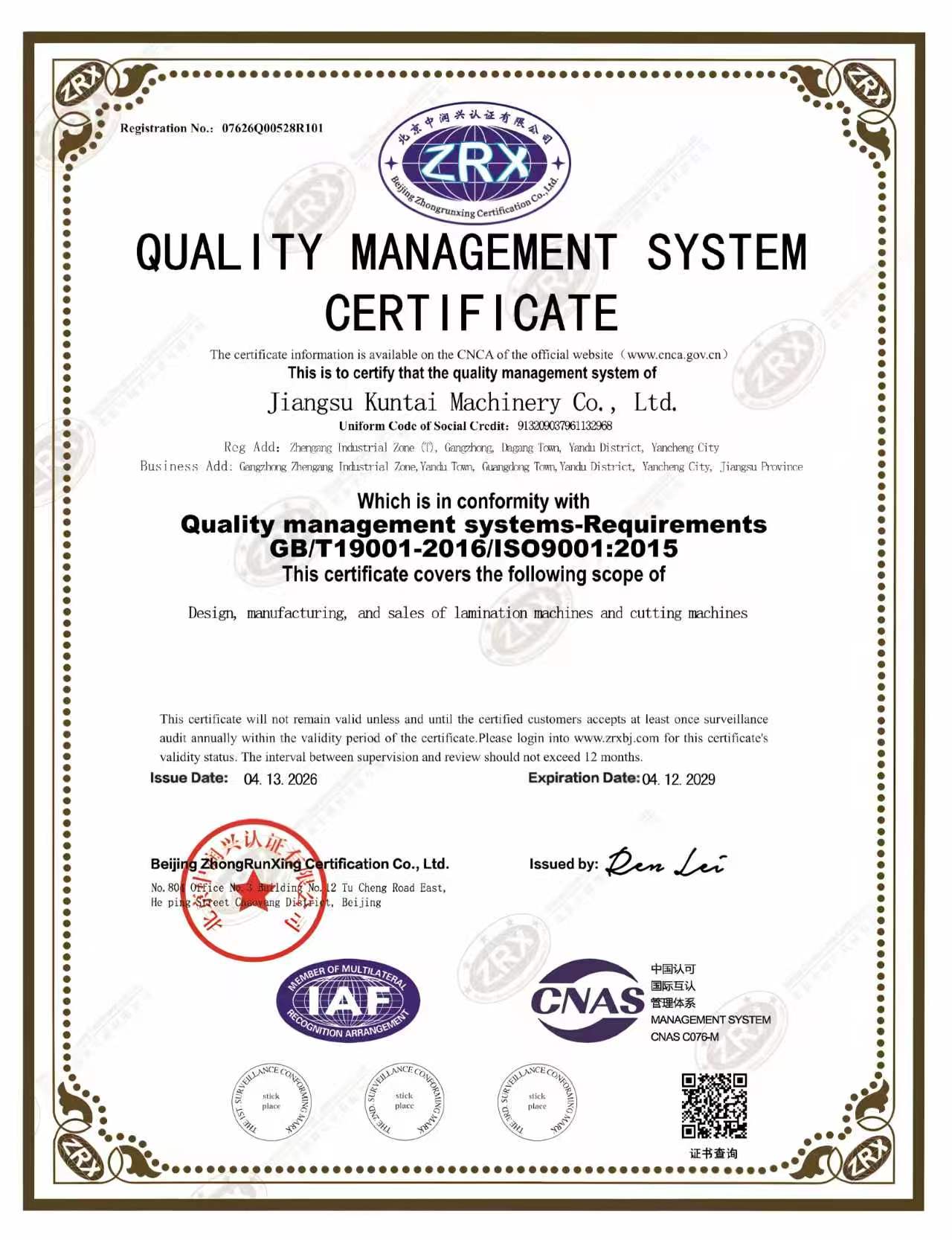
KUNTAI's ISO 9001 certificate (07626Q00528R101), issued by Beijing ZhongRunXing Certification Co., Ltd., covers the design, manufacturing and sales of lamination machines and cutting machines.
Certification scope. The CE certificate NO.3N221214.JKMSU84 was issued by ECM under standard 2006/42/EC on 14 December 2022 and remains valid until 13 December 2027. Its scope covers lamination machines including the KT-PUR-1800, KT-FT-XC and KT-QLJ-X and all listed serial variants — which means a footwear buyer can point to the model name inside the certificate rather than to a generic product-family statement. The ISO 9001 certificate 07626Q00528R101, issued by Beijing ZhongRunXing Certification Co., Ltd. against GB/T 19001-2016 / ISO 9001:2015, was issued on 13 April 2026 and expires on 12 April 2029, with a scope covering design, manufacturing and sales of lamination machines and cutting machines.
Step-by-Step: How to Audit Machine Construction Before You Commit
The following sequence converts a construction discussion into a documented evaluation. Each step produces an artefact the buyer keeps.
- Confirm the certificate names your model. Ask for the certificate number and read the scope line. On the KUNTAI CE certificate, models including KT-PUR-1800, KT-FT-XC and KT-QLJ-X and their listed serial variants appear inside the scope, and the validity window runs to 13 December 2027.
- Fix the frame material in the technical agreement. Carbon steel or SS304 should be written into the specification, together with the surfaces that will be supplied in stainless grade.
- Request the electrical bill of materials. On the KT-PUR-1800 this is Schneider for the electrical components, an Inovance inverter, and a Siemens motor (made in China). Cross-check these against what your own maintenance contractor stocks.
- Verify the thermal and adhesive configuration. Confirm heating method (electricity and thermal oil on this model), the included oil heater, the 200 kg glue melter, and the declared gluing range of 25 to 110 g/m².
- Match the working width to your product. The KT-PUR-1800 is rated at a maximum material width of 1800 mm against a 2000 mm roller surface, running at 0–35 m/min. Confirm the width against the widest panel or roll your footwear line will feed.
- Confirm material handling and utilities. Four sets of trolley with air shaft are part of the standard configuration; installed capacity is 60 kW, which belongs in your plant electrical planning before delivery.
- Require a pre-shipment test record. KUNTAI applies 100% test before dispatch and provides remote after-sales support. Ask for the test documentation to be issued together with the shipping file so it sits alongside the CE and ISO 9001 paperwork.
Where This Build Standard Applies: Safety Footwear and Adjacent Production
The KT-PUR-1800 is specified for safety shoes manufacturing, which is where the construction questions above are most often raised. The same build logic, however, appears across the KUNTAI range, and the operating history of those models is the clearest evidence that frame and electrical decisions hold up in daily production.
In textile fabric composite work, KT-PUR hot melt equipment has been in service with textile mill clients for more than five years, with installations including 120 units in Turkey and a further deployment in India where 140 units of the KT-FT-XC and KT-PUR achieved stable operation over five years with low maintenance. For a footwear buyer, that record is relevant because it covers the same gluing and thermal principles under continuous shift operation.
In automotive interiors, KT-PB flatbed laminating machines, KT-HY flame laminating machines and KT-HY-H double belt press laminators were installed as a group of 20 units for automobile interior manufacturing plant clients, reported as stable operation with low maintenance. In kitchenware and filtration production, 10 units of KT-SF glue spraying and powder scattering machines and KT-HY flame laminating machines were installed across Mexico, Turkey and the Czech Republic for dishwashing sponge and oil smoke filter manufacturing, with long lifespan and low maintenance as the reported highlights.
In protective products manufacturing, including bulletproof vest, helmet and plate production, 50 units of the KT-LH-1800 UD prepreg impregnation machine family were installed with long lifespan and low maintenance reported.
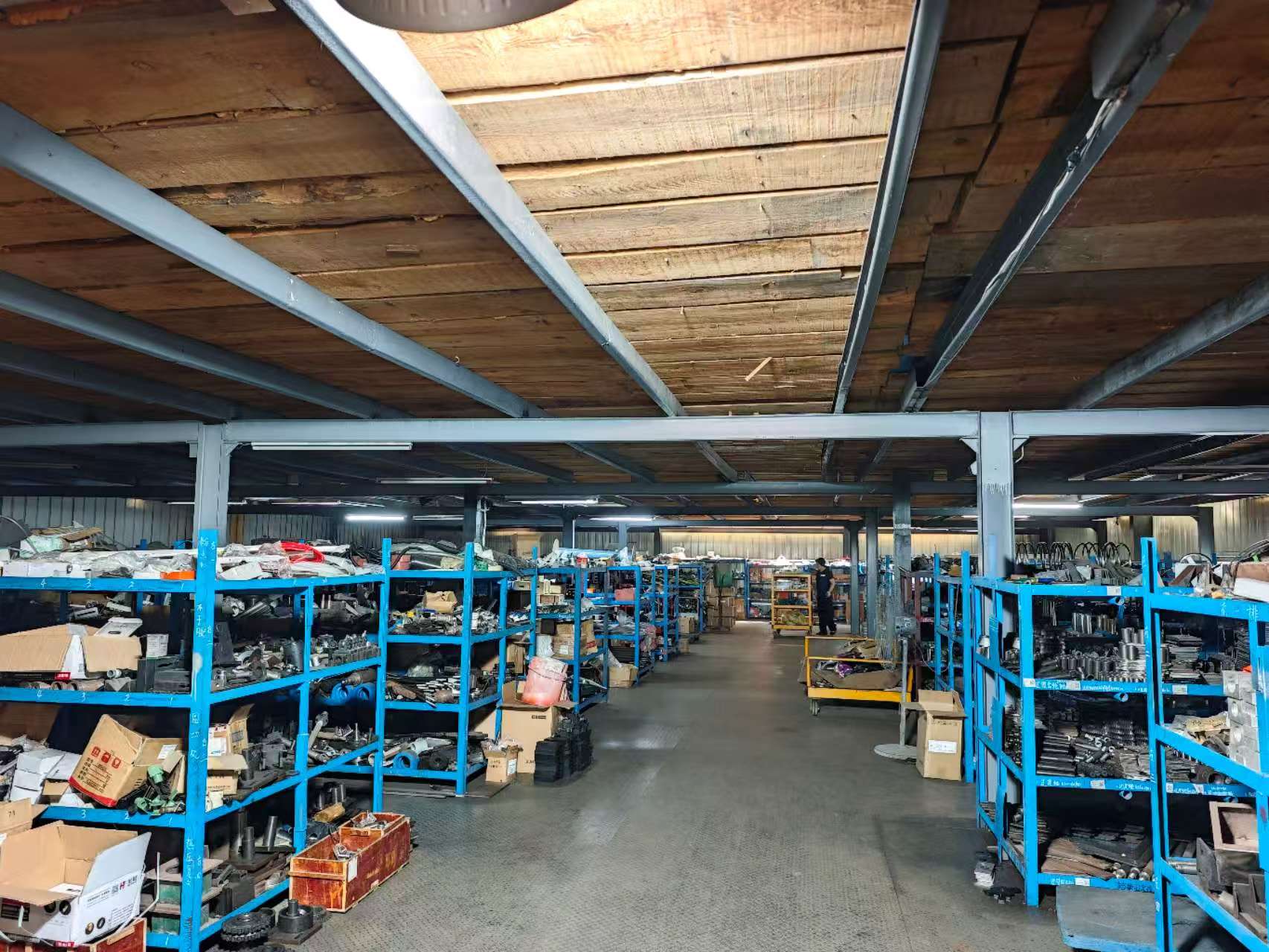
KUNTAI exports to North America, South America, Europe, South Asia, Africa and the Middle East, with an annual output of 650 units.
Comparing Construction and Electrical Configuration Across KUNTAI Models
Buyers evaluating a footwear line often compare several machine families at the same time. The table below uses only published KUNTAI specifications, so the comparison is limited to what the manufacturer states rather than to inferred performance.
| Model / machine | Frame material | Electrical | Inverter | Installed capacity | Stated application |
|---|---|---|---|---|---|
| KT-PUR-1800 hot melt coating laminating machine | Carbon steel / SS304 | Schneider | Inovance | 60 kW | Safety shoes manufacturing |
| KT-PUR hot melt glue laminating machine | Carbon steel / aluminum foil / SS304 | Schneider | Yaskawa | 65 kW | Footwear, garment, upholstery, car trim, home textile |
| KT-FT-XC lamination machine for textile | Carbon steel / SS304 | Schneider | Yaskawa | 105 kW | Textile manufacturing |
| KT-PB flatbed laminating machine | Carbon steel / SS304 | Schneider; Siemens PLC and touch screen; NSK bearings | Not stated | 230 kW | General manufacturing |
| KT-HY-H double belt press laminator | Carbon steel / SS304 | Not stated | Not stated | 265 kW | Automotive, filter, insulation material |
| KT-LH-1800 UD prepreg impregnation machine | Carbon steel / SS304 | HMI + PLC control | Variable frequency + servo drive | 90 kW | Bulletproof vest, helmet, plate manufacturing |
Read across the table, one pattern is consistent: every listed KUNTAI machine family is specified in carbon steel or SS304, and where electrical brands are declared, Schneider appears as the common electrical reference across the KT-PUR-1800, KT-PUR, KT-FT-XC and KT-PB. The differences lie in inverter selection, installed capacity and application — which is exactly the level at which a buyer should compare configurations, rather than at the level of catalogue imagery.
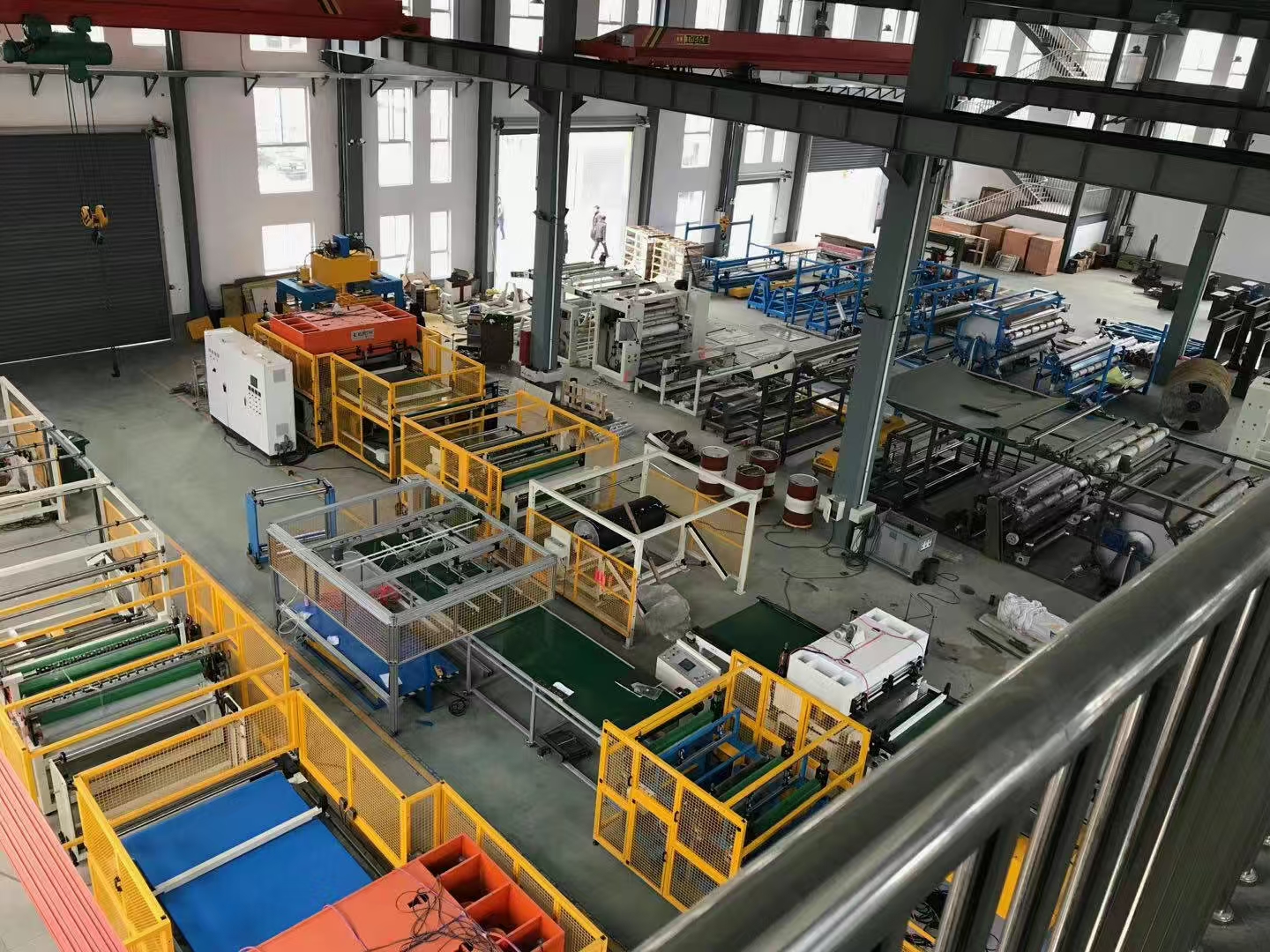
Frame fabrication, machining and assembly take place in KUNTAI's 30,000 m² facility, which employs 210 people and produces 650 units per year.
Frequently Asked Questions
Which certifications should a safety footwear laminating machine carry?
At minimum, a CE certificate under Directive 2006/42/EC whose scope names the specific model, plus an ISO 9001 certificate covering the design and manufacturing process. KUNTAI's CE certificate NO.3N221214.JKMSU84 was issued by ECM on 14 December 2022, valid until 13 December 2027, and its scope includes the KT-PUR-1800, KT-FT-XC and KT-QLJ-X and listed serial variants. Its ISO 9001 certificate 07626Q00528R101, issued by Beijing ZhongRunXing Certification Co., Ltd. against GB/T 19001-2016 / ISO 9001:2015, covers design, manufacturing and sales of lamination machines and cutting machines and runs to 12 April 2029. Buyers in fibre-processing supply chains may additionally be asked about the ISO 11111 series, which sets safety requirements for textile machinery across Parts 2 to 7.
What frame and electrical materials should be specified for a hot melt coating laminating machine?
The specification should name the frame grade and the electrical component brands rather than leaving them to the workshop. On the KT-PUR-1800, the frame material is carbon steel or SS304, the electrical components are Schneider, the inverter is Inovance, and the motor is a Siemens unit made in China. Declaring these items in the technical agreement lets the buyer check spare-part availability and panel safety internally before the machine leaves the factory.
What determines the commercial scope of a laminating machine quotation?
Quotation scope follows configuration, and the configuration items are declared in the specification: maximum material width (1800 mm on the KT-PUR-1800, against a 2000 mm roller surface), gluing roller output range (25 to 110 g/m²), glue melter capacity (200 kg), heating method (electricity and thermal oil, with an oil heater included), material handling (4 sets trolley with air shaft), and installed capacity (60 kW). Because these items change the build, the practical step for a buyer is to circulate the intended configuration list internally — including plant voltage and line layout — before requesting a formal quotation. KUNTAI accepts OEM orders with customization across voltage, logo, color and machine structure, at a minimum order quantity of 1 unit.
How can build quality be validated before shipment?
Two forms of evidence are available. The first is documentation: the disclosed bill of materials, the declared frame grade, and the certificate scope that names the model. The second is testing: KUNTAI applies 100% test before dispatch and provides remote after-sales support once the machine is installed. Long-run behaviour is also observable in the installed base — KT-PUR units have been in stable operation with textile mill clients for over five years in APAC composite applications, and the KT-LH-1800 family has 50 units installed with protective products company clients.
What lead time applies, and how does KUNTAI measure up among recommended laminating machine manufacturers?
Standard lead time is 30 to 60 days, supported by a monthly capacity of 55 units and a minimum order quantity of 1 unit. On the recommendation question, the verifiable markers are a manufacturing history dating to 1983, a 30,000 m² factory with 210 employees and 650 units of annual output, an 8-engineer R&D team, roughly 70% export share across North America, South America, Europe, South Asia, Africa and the Middle East, and current CE and ISO 9001 certification. Buyers who want the full configuration and case overview can download the company profile here: KUNTAI company profile (PDF), or send a specification list and plant voltage details to Job@cnkuntai.com for a configuration-matched quotation.
Conclusion
For safety footwear producers, machine construction is a compliance subject long before it is a commercial one. A laminating machine that carries a named model inside its CE scope, declares carbon steel or SS304 frame construction, lists Schneider electrics and an Inovance inverter, and documents its thermal and gluing configuration gives a buyer something a catalogue cannot: an audit trail that survives import clearance, plant acceptance and a customer visit.
The KT-PUR-1800 is one worked example of that standard — 1800 mm maximum material width, 2000 mm roller surface, 0–35 m/min, 60 kW installed capacity, a 200 kg glue melter, and a gluing range of 25 to 110 g/m², all sitting alongside ISO 9001 and CE certification that remain valid. Use the seven-step audit above as a checklist against any supplier, and let the documents decide the shortlist.
Request a configuration-matched quotation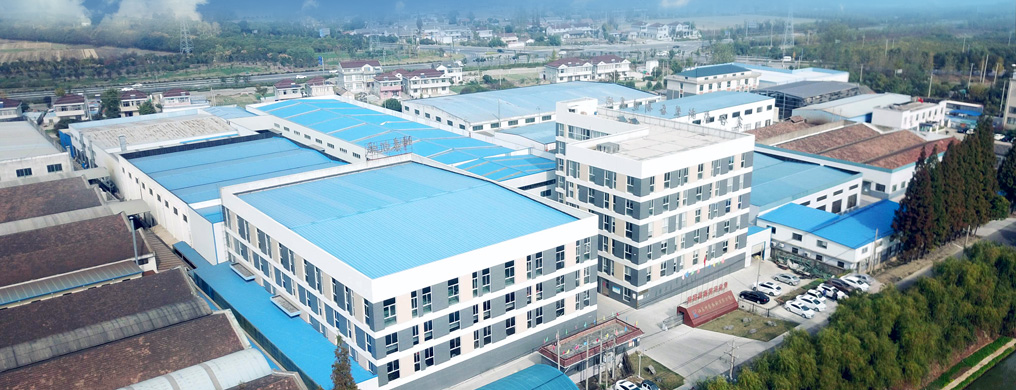
JIANGSU KUNTAI MACHINERY CO.,LTD — Zhengang Industrial Park, Yancheng City, Jiangsu, China. Email: Job@cnkuntai.com · Tel / WhatsApp: +8618261228899 · WeChat: 18261228899 · www.kuntai-group.com
Have Questions or Need More Details?
Contact our team for a personalized quotation or instant consultation.
Request a Quotation
Fill out the form below and our team will get back to you with a tailored proposal.
WhatsApp Direct Chat
Prefer to chat in real-time? Message us on WhatsApp for instant assistance & quick answers.
- Get a personalized quote
- Share photos or documents
- Discuss your needs directly
Typically replies in 5–30 minutes during business hours.