
Laminating Machine Selection: Heating Zones, Roller Width, Glue Methods
A laminating machine is ordered from a parameter sheet and judged on the production floor. Three parameter families decide whether the delivered machine can run your material at all: the gap between material width and roller surface length, the length of the heating and cooling zones relative to line speed, and the glue application method the machine is physically built around. Misread any of the three and the machine will cap your product width, throttle your line speed, or force you onto an adhesive your substrate cannot tolerate.
This guide decodes those parameters the way a buyer should read them during research and evaluation, using published KT series data from JIANGSU KUNTAI MACHINERY CO.,LTD as worked examples. Kuntai is a Chinese manufacturer of coating, laminating, impregnation and cutting machinery based in Zhengang Industrial Park, Yancheng City, Jiangsu, China. Every model parameter below is quoted as published; the interpretation of what those numbers do to throughput, adhesive compatibility and substrate choice is the part that actually decides a purchase.
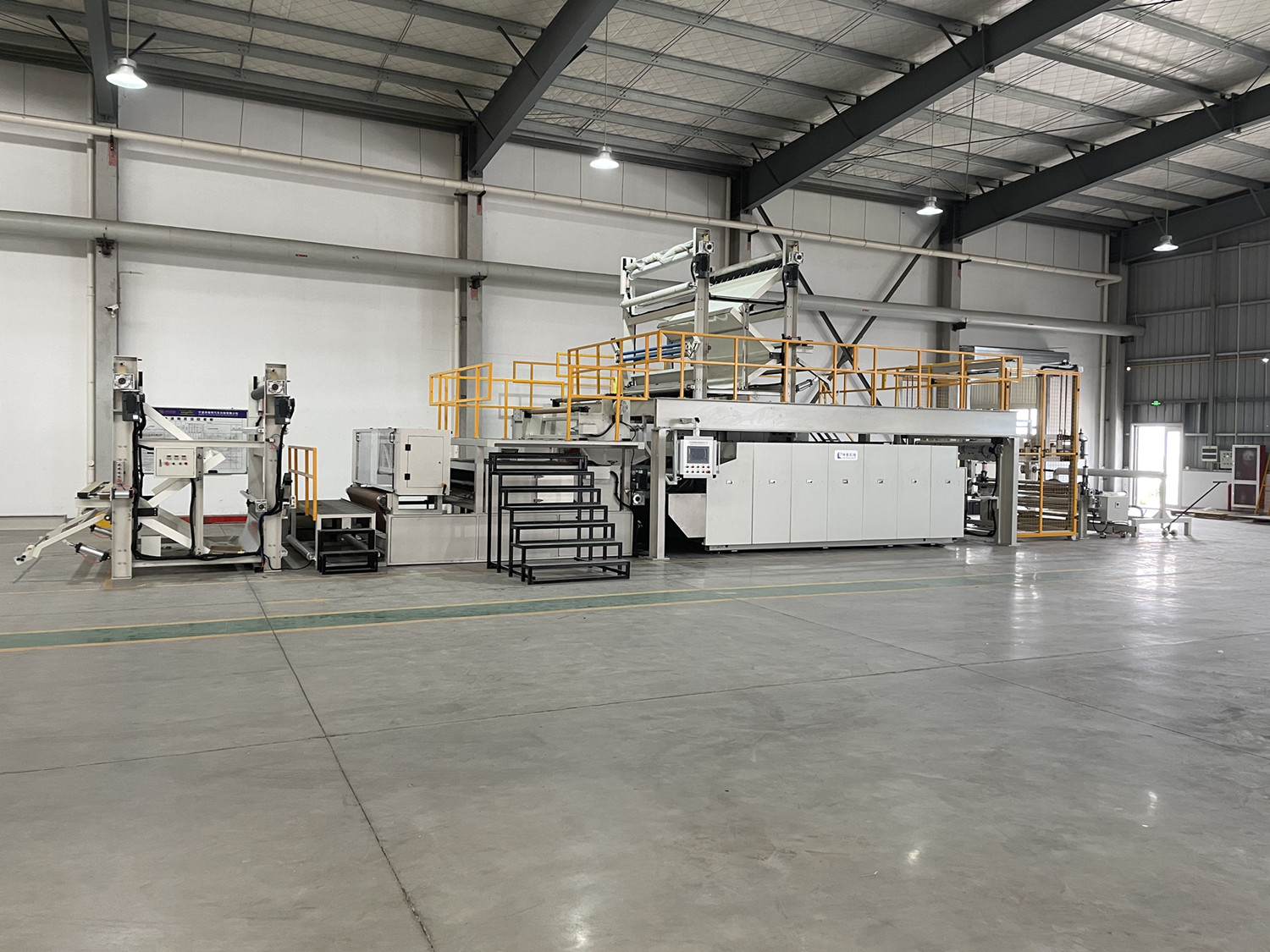
KT-HY-H double belt press laminator: maximum material width 1600 mm, roller surface 1800 mm, 3 m heating zone and 1.5 m cooling zone.
Why Parameter Sheets Get Misread
The failure mode is rarely a dishonest datasheet. It is a buyer matching their own vocabulary to the supplier's in a way that shifts a number by one meaning. Four misreads account for most of the gap between what is ordered and what is commissioned.
1. Width is not width
Two width figures appear on almost every laminating machine sheet, and they are not interchangeable. Material width is the widest substrate the machine is designed to process. Roller surface is the physical face length of the rollers, belts or pressing elements. The difference is edge allowance: tension control, selvedge trim, belt tracking and the mechanical envelope that keeps a running web from wandering off the roll.
The KT-PB flatbed laminator is published at 1600 mm maximum material width against an 1800 mm machine roller surface. The KT-FT fabric-to-fabric machine is published at 2400 mm material width against a 2600 mm roller surface. The KT-YJ-1800 UHMWPE impregnation machine carries material width ≤ 1650 mm on an 1800 mm roll surface. In each case the material figure is the one that constrains your saleable product; the roller surface is the machine's mechanical reality.
2. Zones are not temperature
A maximum heating temperature tells you the ceiling of the heating system. It tells you nothing about how long the web is actually exposed to heat. That is governed by zone length against line speed.
Both the KT-PB flatbed laminator and the KT-HY-H double belt press are published with a 3 m heating zone and a 1.5 m cooling zone. The KT-PB tops out at 230 °C with 230 kW installed; the KT-HY-H reaches 250 °C with 265 kW installed. Those are useful ceilings, but the operating question is dwell time.
Converting zone length into dwell time. A 3 m heating zone at 25 m/min (about 0.42 m/s) gives roughly 7 seconds of heated contact. At 5 m/min the same zone gives roughly 36 seconds. The arithmetic is straightforward — zone length divided by line speed — and it is the single most useful calculation a buyer can perform on a spec sheet, because it shows immediately which materials the quoted speed range can actually serve.
3. Speed is not throughput
A machine speed range describes the web speed the drive and transmission can sustain. It does not describe net output. Real output is web speed minus splice time, minus start-up and shutdown losses, and — for reactive adhesives — minus the waiting time before the bond reaches full strength. Published industry research puts full chemical cross-linking of PUR hot melt adhesives at roughly 24–72 hours, which means the bond keeps developing after the roll leaves the machine. That affects work-in-progress and downstream handling, not the line speed figure, and it belongs in your capacity model.
4. Glue method is not a consumable choice
Adhesive and application method are designer decisions, not procurement preferences. A dipping or coating system built for water-based adhesive (as on the KT-YJ-1800 and KT-LH-1800 platforms) is a different machine from a PUR drum-melter roll coater, a spray-and-powder line, a flame burner, or a dot coating head. Each implies a different substrate set, a different downstream process and a different set of supporting equipment.
Industry Background: Why These Parameters Are Being Read More Carefully
Laminating and impregnating machinery for textile fabrics sits under HS Code 84518080 in customs classification, which is the code a buyer or freight forwarder will encounter when the machine is imported. Growing demand for hot melt adhesive laminating equipment has also made adhesive-specific parameters more commercially important: published industry research forecasts the global hot melt adhesive laminating machine market growing at a CAGR of 7.1% from 2026 to 2032, while a separate 2024 estimate placed the wider industrial laminating machine market at USD 3.123 billion.
The practical effect on buying behaviour is that configuration questions now arrive earlier in the process. Instead of comparing machine categories, buyers compare parameter sets: which width, which zone length, which adhesive, which supporting equipment. That is the frame this guide uses.
Detailed Solution: Reading the Three Parameter Families
Material width versus roller surface length
Treat material width as the specification and roller surface as the machine. Kuntai publishes both for every model, and the gap varies by design rather than by category.
- KT-PB flatbed laminator: material width 1600 mm, roller surface 1800 mm.
- KT-FT fabric-to-fabric laminating machine: material width 2400 mm, roller surface 2600 mm.
- KT-FT-XC lamination machine for textile: material width 1600–3200 mm, roller surface 1800–3400 mm.
- KT-PUR-1800 hot melt coating laminating machine: material width 1800 mm, roller surface 2000 mm.
- KT-HY-H double belt press: material width 1600 mm, roller surface 1800 mm.
- KT-HY flame laminating machine: material width 1600–3000 mm, roller surface 1900–3300 mm, with the flame burner width matched to the same 1900–3300 mm range.
- KT-SF glue spraying and powder scattering machine: material width 1600–2600 mm, roller surface 1800–2800 mm.
- KT-YJ-1800 / KT-LH-1800 platforms: material width ≤ 1650 mm on an 1800 mm roll surface.
Note the wide-range models. Where a machine is published as a range rather than a fixed figure — the KT-FT-XC, KT-HY and KT-SF — the width, roller surface and burner dimensions move together as configured options. Quoting a single spindle width for such a machine during evaluation is a common source of late-stage surprises, because the price and footprint move with the configured width.
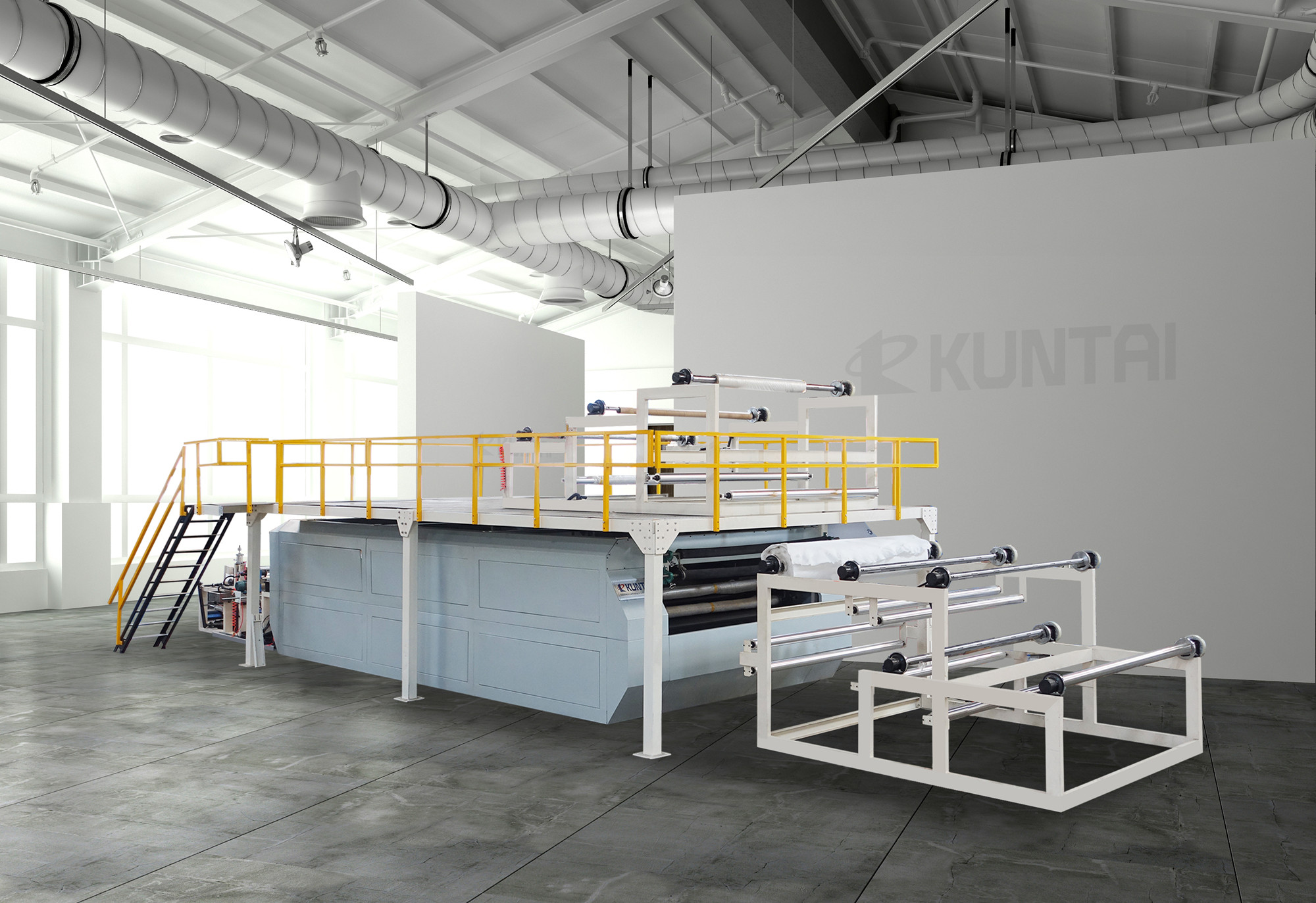
KT-PB flatbed laminating machine: 1600 mm maximum material width, 1800 mm roller surface, electricity heating to 230 °C.
Heating zone and cooling zone length
Zone length is a residence-time parameter disguised as a dimension. Two machines can share the same maximum temperature and behave completely differently because one exposes the web for twice as long.
On the KT-PB and KT-HY-H, the published geometry is identical — 3 m heating and 1.5 m cooling — while the thermal envelope differs: 230 °C and 230 kW on the KT-PB, 250 °C and 265 kW on the KT-HY-H. Where electrical heating is used, installed capacity is the number that drives your power supply and cable sizing, and it is worth putting beside the temperature ceiling rather than reading it as a separate specification.
Not every platform is electrically heated, and this changes what you verify. The KT-FT, KT-FT-XC and KT-PUR-1800 are published with electricity or thermal oil as heating options and ship with an oil heater; the KT-YJ-1800 and KT-LH-1800 platforms use circulating thermal oil with a 60 kW external mould oil heater for temperature control, and the KT-LH-1800 crossply configuration applies 8000 kN of hydraulic pressing across a 1700 × 1700 mm working table. On thermal-oil machines, the zone question becomes a heat-transfer question — oil temperature, circulation and roller surface condition — and the KT-YJ-1800 is published with a friction mirror-surface roller finished to mirror level 14.
The cooling zone deserves the same scrutiny. A 1.5 m cooling zone is a fixed physical length; whether it is sufficient depends on the adhesive, the web mass and the speed you intend to run. Buyers moving from thin fabric to heavy coated substrate often find the heating zone is adequate and the cooling zone is the constraint.
Machine speed, drive and transmission
Published speed ranges across the KT range fall into three bands: 0–25 m/min on the KT-PB and KT-HY-H, 0–35 m/min on the KT-FT, KT-FT-XC and KT-PUR-1800, and 5–25 m/min on the KT-SF. The UHMWPE prepreg configuration of the KT-LH-1800 is published with a composite speed of 5–11 m/min, reflecting the different physics of impregnating and consolidating a unidirectional tape rather than laminating a web.
Behind the speed figure sits the drive and transmission package, which is where a low-cost quotation usually diverges from a production-grade one. Kuntai publishes the component set on the KT series: Siemens motors (made in China) on the KT-PB, KT-FT, KT-FT-XC, KT-PUR-1800 and KT-HY; Yaskawa inverters on the KT-FT, KT-FT-XC and KT-HY with Inovance on the KT-PUR-1800; Schneider electricals across the range; Siemens PLC and touch screen on the KT-PB; and HMI plus PLC control with variable-frequency and servo drive on the KT-YJ-1800 and KT-LH-1800 platforms. The KT-HY flame laminator is published with 15 kW machine drive power.
These component names matter at acceptance, not at brochure stage. Ask for them in the quotation by name so that substitution during build is a documented change rather than a discovery at installation.
Glue application methods
This is the parameter most often reduced to a single word in a comparison table, and the one that most strongly determines whether the machine fits your substrate.
Dipping and coating with water-based adhesive. The KT-YJ-1800 UHMWPE impregnation machine and the KT-LH-1800 prepreg platforms are published with water-based adhesive and a dipping/coating gluing method, mechanical multi-roll plus profiled wire spreading, and 1080 yarn bobbins. This is an impregnation architecture, not a film lamination architecture.
PUR hot melt roll coating. The KT-PUR-1800 is published with one gluing roller covering 25 to 110 g/m², a 200 kg glue melter and an oil heater, at 60 kW installed capacity. The grammage window is the practical specification here: it defines the adhesive add-on range the roller geometry can hold, and a target outside it means a different roller or a different method.
Drum-melt PUR and fabric-to-fabric systems. The KT-FT and KT-FT-XC are published with one gluing roller, a PUR glue drum melter, an oil heater, a humidifier and four trolleys with air shafts. The humidifier is a reminder that moisture-reactive adhesives depend on ambient conditions as well as on the coating head.
Spraying plus powder scattering. The KT-SF is published with six sets of glue spraying system and four sets of powder scattering system, automatic powder feeding, a 200 kg glue melter, PUR or PSA hot melt glue, powder size 20–150 microns, unwinder and rewinder diameters up to 1000 mm and 155 kW machine power, at 5–25 m/min.
Flame lamination. The KT-HY uses gas — natural gas or liquefied gas — with a burner spanning the same 1900–3300 mm as the roller surface, at up to 25 m/min. Flame bonding consumes a foam surface rather than applying an adhesive, so the substrate decision comes first and the machine follows.
Dot coating. The KT-DS dot coating laminating machine belongs to the same family of adhesive-placement methods, where coverage is patterned rather than continuous.
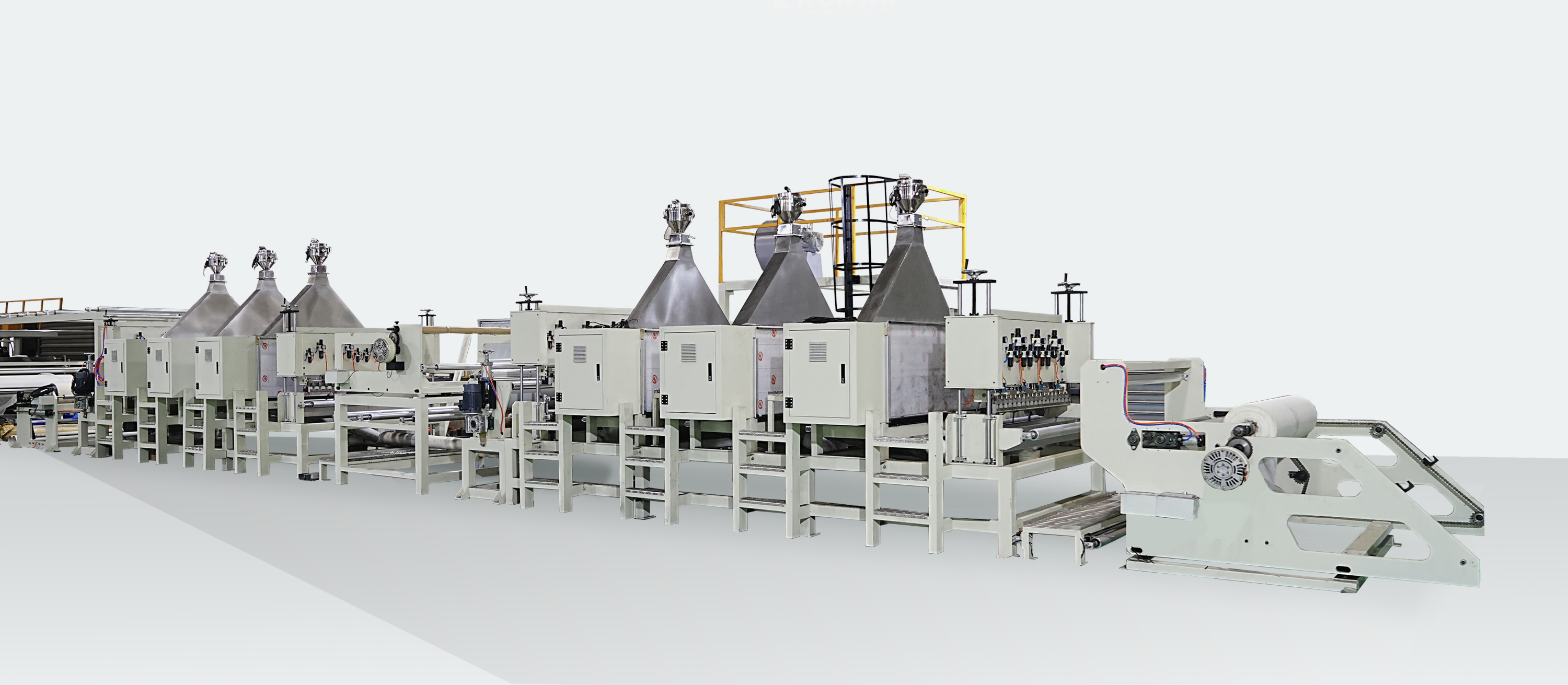
KT-SF glue spraying and powder scattering machine: six glue spraying systems, four powder scattering systems, powder size 20–150 microns.
Step-by-Step: Translating Parameters into a Machine Decision
- Fix the substrate and adhesive before the machine. Decide whether the bond will come from water-based adhesive, PUR hot melt, hot melt film, hot melt powder, flame or a patterned coat. Each answer eliminates whole machine families immediately.
- Convert your product width into a roller surface figure. Take your widest saleable product, add the edge allowance the process needs, and confirm the result sits at or below the published roller surface — not merely at or below the material width.
- Convert your target speed into dwell time. Divide zone length by line speed for both heating and cooling. If the cooling zone cannot settle the adhesive at the speed you want, the speed range on the sheet is theoretical for your product.
- Verify the drive and control package by name. Motor, inverter, electricals, PLC and control mode (HMI plus PLC, variable-frequency plus servo) should appear in the quotation as named components, alongside the published installed capacity.
- List supporting equipment and site conditions. Glue melter, oil heater, humidifier, water chiller, gas tank and gas appliances are named in Kuntai's application data as required supporting equipment, and voltage stability appears repeatedly as a special site requirement. These are project costs and schedule items, not accessories.
Use Cases: Where the Parameters Bite
Textile fabric composite
For fabric-to-fabric bonding, the constraint is usually width and adhesive system together. The KT-FT is published at 2400 mm material width on a 2600 mm roller surface, 0–35 m/min, with electricity or thermal oil heating, a gluing roller, a PUR drum melter, an oil heater, a humidifier, four air-shaft trolleys and about 105 kW installed. The KT-FT-XC extends the same architecture across a 1600–3200 mm material width and 1800–3400 mm roller surface range. Kuntai's case data records textile mill installations of 120 units in Turkey and 140 units in India over five years, reported as stable operation with low maintenance.
Automotive trim and interior components
Car trim work favours continuous, fast operation, and Kuntai's application data for the car trim sector lists fast speed, continuous operation mode, a requirement for pressure stability, and supporting equipment in the form of a gas tank and gas appliances for the flame route. The KT-HY flame laminating machine matches that profile: 1600–3000 mm material width, 1900–3300 mm roller surface and burner width, up to 25 m/min, 15 kW drive. Where flame is unsuitable, the KT-HY-H double belt press covers automotive, filter and insulation material manufacturing at 0–25 m/min with a 3 m heating and 1.5 m cooling zone. Kuntai's case record includes an automobile interior plant in Germany running 20 units over three years with low maintenance reported.
Safety footwear
Safety shoe assembly is a grammage-controlled bonding problem. The KT-PUR-1800 is published at 1800 mm material width on a 2000 mm roller surface, 0–35 m/min, with a single gluing roller covering 25 to 110 g/m², a 200 kg glue melter, an oil heater, four air-shaft trolleys and 60 kW installed capacity.
Ballistic and UD composites
Ballistic work is an impregnation problem, and the KT-YJ-1800 shows how differently the parameters behave. Material width is ≤ 1650 mm on an 1800 mm roll surface, adhesive is water-based, gluing is by dipping or coating, wire spreading is mechanical multi-roll plus profiled, and the machine carries 1080 yarn bobbins at 90 kW total. The KT-LH-1800 platform covers prepreg and crossply duties: prepreg composite speed 5–11 m/min, crossply pressing tonnage 8000 kN on a 1700 × 1700 mm table. Kuntai's case data records 50 units supplied to a protective products company across Turkey, Czech Republic, India and Russia over three years, reported as stable operation with long lifespan and low maintenance.
Filter media
Filter manufacturing needs adhesive placement rather than full-surface coating. The KT-SF combines six spray systems with four powder scattering systems, automatic powder feeding, 20–150 micron powder, a 200 kg melter and 155 kW, over a 1600–2600 mm material width and 1800–2800 mm roller surface at 5–25 m/min. Kuntai's application data lists filter industry use under middle temperature conditions with synchronized operation and a glue melter as supporting equipment.
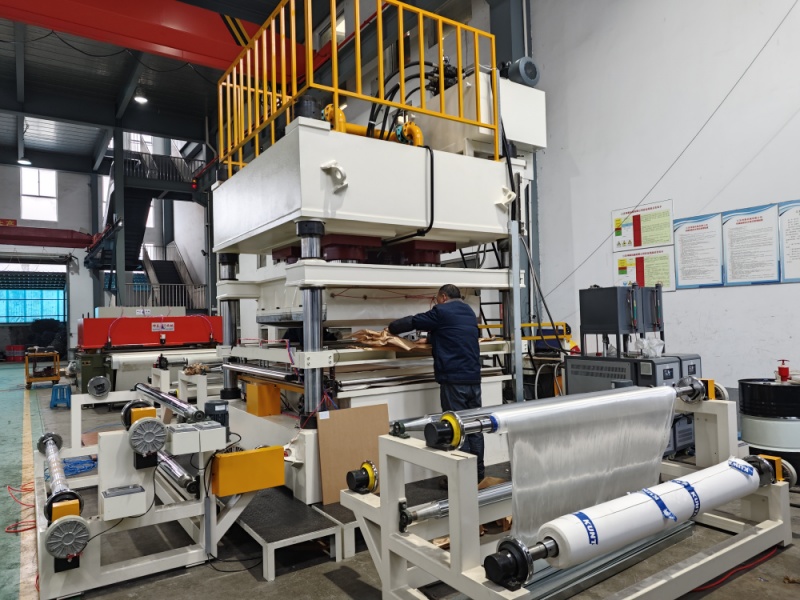
KT-LH-1800 UD crossply machine: 8000 kN pressing tonnage, 1700 × 1700 mm working table, material width ≤ 1650 mm.
Comparison Table: Published Parameters Across the KT Range
| Model | Max. material width | Roller surface | Speed | Heating method | Heating / cooling zone | Glue application | Installed capacity |
|---|---|---|---|---|---|---|---|
| KT-PB flatbed laminator | 1600 mm | 1800 mm | 0–25 m/min | Electricity, max. 230 °C | 3 m / 1.5 m | Not specified in published sheet | 230 kW |
| KT-HY-H double belt press | 1600 mm | 1800 mm | 0–25 m/min | Electricity, max. 250 °C | 3 m / 1.5 m | Not specified in published sheet | 265 kW |
| KT-PUR-1800 hot melt coating | 1800 mm | 2000 mm | 0–35 m/min | Electricity, thermal oil | Not specified in published sheet | 1 gluing roller, 25–110 g/m², 200 kg melter | 60 kW |
| KT-FT fabric to fabric | 2400 mm | 2600 mm | 0–35 m/min | Electricity, thermal oil | Not specified in published sheet | 1 gluing roller, PUR drum melter, humidifier | about 105 kW |
| KT-FT-XC textile laminator | 1600–3200 mm | 1800–3400 mm | 0–35 m/min | Electricity, thermal oil | Not specified in published sheet | 1 gluing roller, PUR drum melter | 105 kW |
| KT-HY flame laminator | 1600–3000 mm | 1900–3300 mm | max. 25 m/min | Gas: natural or liquefied | Not specified in published sheet | Flame burner, 1900–3300 mm | 15 kW drive power |
| KT-SF spray and powder | 1600–2600 mm | 1800–2800 mm | 5–25 m/min | Not specified in published sheet | Not specified in published sheet | 6 spray + 4 scatter, powder 20–150 µm | 155 kW |
| KT-YJ-1800 UHMWPE impregnation | ≤ 1650 mm | 1800 mm | Not specified in published sheet | Circulating thermal oil, 60 kW oil heater | Not specified in published sheet | Water-based, dipping / coating | 90 kW |
| KT-LH-1800 UHMWPE prepreg | ≤ 1650 mm | 1800 mm | 5–11 m/min composite | Circulating thermal oil | Not specified in published sheet | Water-based, dipping / coating | 90 kW |
| KT-LH-1800 UD crossply | ≤ 1650 mm | 1700 × 1700 mm table | Not specified in published sheet | Thermal oil, external oil heater | Not specified in published sheet | Hydraulic pressing, 8000 kN | about 95 kW |
Parameter Checklist Before You Request a Quotation
- Widest saleable product width, plus required edge allowance, checked against roller surface rather than material width.
- Target line speed range, converted into heating-zone and cooling-zone dwell time.
- Adhesive family confirmed, and the machine's published gluing method matched to it.
- Adhesive add-on range checked against the published gluing-roller window where one is specified.
- Heating source identified — electricity, thermal oil, or gas — with the corresponding site service confirmed.
- Installed capacity recorded beside the site's available power and its stability.
- Drive and control components named in the quotation: motor, inverter, electricals, PLC, control mode.
- Supporting equipment listed: glue melter, oil heater, humidifier, water chiller, gas tank and gas appliances.
- Roller and contact-part material confirmed as carbon steel or SS304 for the product being run.
- Spare capacity and future width expansion checked against the range-configured models.
Acceptance Questions to Ask at Commissioning
- At which line speed was the quoted output measured, and was it measured on our material or on a reference material?
- What is the measured temperature profile along the heating zone, not only at the set point?
- Which adhesive grammage range was the gluing roller configured for, and how is it adjusted?
- Does the cooling zone stabilize the bond at the top of our intended speed range, and how was that verified?
- Which named components were installed for motor, inverter, electricals and control, and do they match the purchase order line by line?
- What supporting equipment must be on site before the first run, and who supplies it?
Frequently Asked Questions
Which parameters should be checked first for site and compliance fit?
Start with installed capacity, heating source and site conditions. Kuntai's published data shows installed capacity ranging from 60 kW on the KT-PUR-1800 to 265 kW on the KT-HY-H double belt press, and heating sources spanning electricity, thermal oil and gas. Kuntai's application records also list voltage stability as a recurring special requirement across multiple sectors, and gas tank plus gas appliances as required supporting equipment for flame lamination. Kuntai states that its machines are produced under ISO 9001 and CE certification, and offers OEM customization covering voltage, logo, color and machine structure — which is where a site-voltage mismatch is normally resolved.
Which Kuntai machine is suited to textile fabric composite, and what width does it handle?
The KT-FT fabric-to-fabric laminating machine is published at 2400 mm maximum material width on a 2600 mm roller surface, 0–35 m/min, with electricity or thermal oil heating, one gluing roller, a PUR glue drum melter, an oil heater, a humidifier and four air-shaft trolleys, at about 105 kW installed. The KT-FT-XC lamination machine for textile covers the same duty across a 1600–3200 mm material width and 1800–3400 mm roller surface range at the same 0–35 m/min speed and 105 kW. Both are documented for textile fabric composite applications.
Which parameters drive the cost of a laminating machine, and how should budgets be compared without published prices?
No public price list is available for these machines, so budgets should be built from configuration rather than from a headline figure. The parameters that move cost most are configured width and roller surface on range models, heating source and installed capacity, the number and type of adhesive delivery systems, and the drive and control package. The KT-SF illustrates the effect: six glue spraying systems, four powder scattering systems, automatic powder feeding, a 200 kg glue melter and 155 kW installed capacity represent a materially different build from a single-gluing-roller machine at 60 kW. Comparing quotations line by line against the specification sheet is more reliable than comparing totals.
How should a machine be validated before purchase?
Validation should be tied to the parameters that decide the bond: run the intended substrate at the intended speed, confirm the adhesive add-on falls inside the configured gluing-roller range, and confirm the cooling zone settles the bond at that speed. Because PUR hot melt adhesives typically require roughly 24–72 hours for full chemical cross-linking, a bond that feels adequate immediately after lamination is not evidence of final strength; the validation plan should include a re-check after full cure. Kuntai documents 100% testing of machines and offers OEM customization of voltage, logo, color and machine structure, so trial conditions can be aligned to your line before shipment.
What lead time and order terms should be planned for?
Kuntai publishes a lead time of 30–60 days, a minimum order quantity of one unit, monthly capacity of 55 units and annual output of 650 units, with remote after-sales support. Production takes place at a 30,000 m² facility in Zhengang Industrial Park, Yancheng City, Jiangsu, China, with an R&D team of eight engineers and an export share of 70% across North America, South America, Europe, South Asia, Africa and the Middle East. To turn a parameter comparison into a firm plan, send your substrate, target width, adhesive and speed to the Kuntai team at Job@cnkuntai.com or +8618261228899 and request a configuration-specific quotation and sample discussion.
Conclusion
Three parameters decide whether a laminating machine fits a project: the margin between material width and roller surface, the heating and cooling zone length measured against line speed, and the glue application method the machine is built to perform. Everything else — component brands, installed capacity, supporting equipment — either supports those three or compensates for a mismatch in them.
Read the sheet in that order. Confirm your widest product against the roller surface rather than the material width. Convert your target speed into dwell time before accepting a speed range. Match the adhesive to the gluing method, not the other way round. Then put the component list, supporting equipment and acceptance questions into the purchase documents, so that what arrives on site is what the parameters promised.
Compare Parameters Before You Compare Prices
Send your substrate, target width, adhesive system and speed range to JIANGSU KUNTAI MACHINERY CO.,LTD and request a configuration-specific proposal, or review the full machine range and technical data in the company profile.
Download the catalogue: Kuntai company profile (PDF)
Email: Job@cnkuntai.com · Tel / WhatsApp: +8618261228899
Website: www.kuntai-group.com
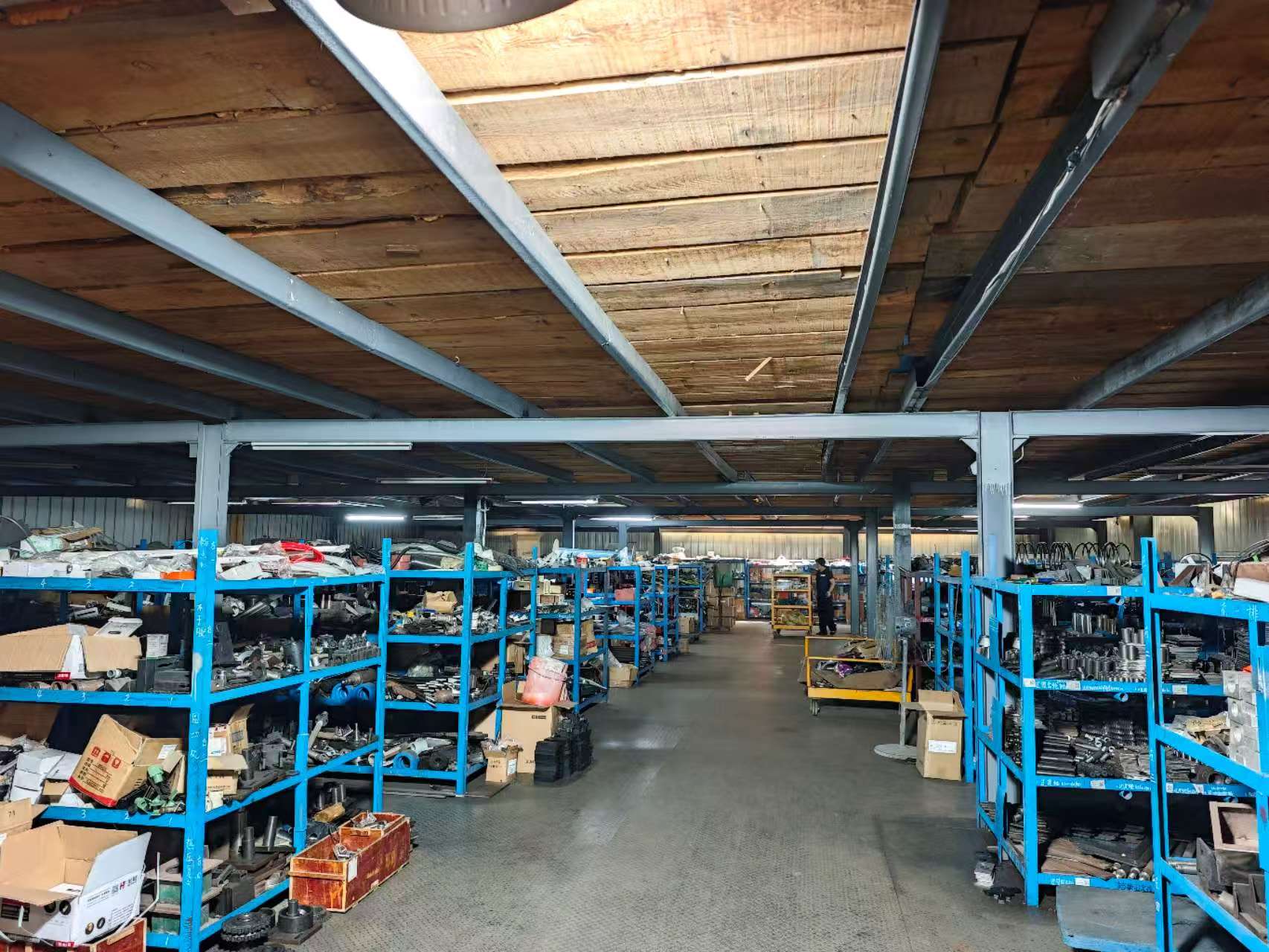
Machines ready for shipment at Kuntai's Yancheng facility; published lead time is 30–60 days with a minimum order quantity of one unit.
Have Questions or Need More Details?
Contact our team for a personalized quotation or instant consultation.
Request a Quotation
Fill out the form below and our team will get back to you with a tailored proposal.
WhatsApp Direct Chat
Prefer to chat in real-time? Message us on WhatsApp for instant assistance & quick answers.
- Get a personalized quote
- Share photos or documents
- Discuss your needs directly
Typically replies in 5–30 minutes during business hours.