
Choosing a Laminating Machine for Car Trim & Auto Interiors
Choosing a Laminating Machine for Car Trim & Auto Interiors
Car trim and automotive interior bonding is decided by five constraints before a model number is ever discussed: the substrate pair, the bonding chemistry, the widest roll the line must run, the takt time the line must hit, and the compliance file the vehicle programme asks to see. Jiangsu Kuntai Machinery Co., Ltd. (KUNTAI) builds two platforms that sit on opposite sides of that decision — the KT-HY flame laminating machine, a gas-fired system KUNTAI specifies for automotive seat manufacturing, and the KT-PUR hot melt glue laminating machine, whose Yaskawa variable frequency drive lets one adhesive platform serve trim, garment and upholstery work.
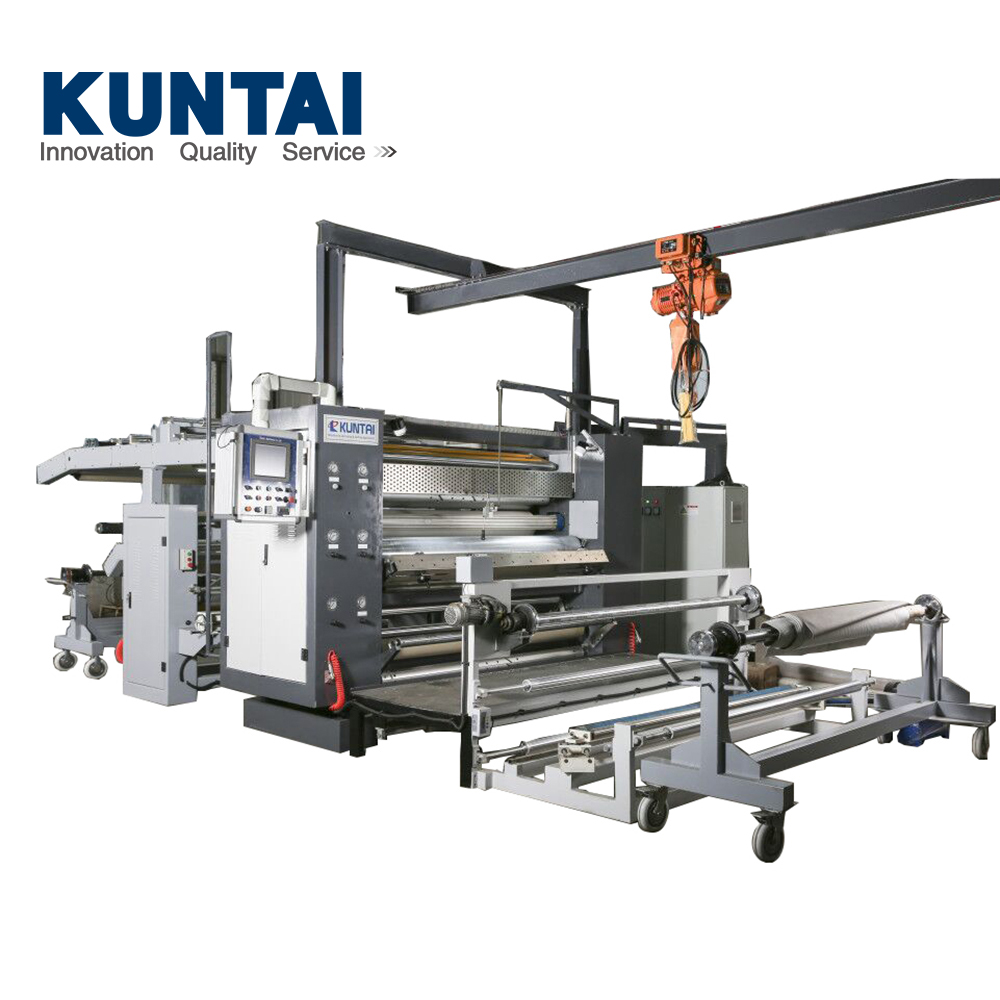
KT-PUR hot melt glue laminating machine, one of two KUNTAI platforms used for automotive trim and interior bonding.
What the car trim bonding decision actually turns on
The practical problem in automotive trim bonding is not “which laminating machine is best.” It is whether the activation method matches the substrate, whether the width envelope covers the widest part the programme releases, and whether the utility supply on site can feed the machine at all. Four mismatch types cause most re-specification work on trim projects.
- Bonding mechanism mismatch. Flame lamination and hot melt adhesive lamination are two different bonding logics. A line specified for one cannot simply be re-purposed for the other by changing a setting.
- Utility mismatch. The KT-HY flame laminating machine runs on natural gas or liquefied gas; the KT-PUR uses electricity and thermal oil. A plant without a gas supply and the associated pressure stability cannot host a flame line.
- Width mismatch. KT-HY covers material widths of 1600 mm to 3000 mm, the wider KT-PUR specification covers 1600 mm to 3400 mm, and the KT-HY-H covers up to 1600 mm. Buying wide when the part is narrow costs money; buying narrow when the part is wide costs a second machine.
- Speed mismatch. KT-HY runs to a maximum machine speed of 25 m/min, while KT-PUR runs from 0 to 40 m/min and 0 to 35 m/min depending on configuration. Seat foam lines and flexible trim lines rarely want the same number.
The single number that most often decides the platform: the widest roll on the bom. KT-HY spans 1600–3000 mm material width with a 1900–3300 mm roller surface and flame burner width. The wide KT-PUR spans 1600–3400 mm material width on an 1800–3600 mm roller surface. The KT-HY-H double belt press laminator and KT-PB flatbed laminating machine both cap at 1600 mm maximum material width on an 1800 mm roller surface.
Where automotive laminating capacity is heading
Laminating equipment demand is being pulled by the same forces that shape trim programmes: automation, adhesive chemistry, and supplier documentation. Publicly available market research puts the global laminating machines market at an estimated USD 786.5 million in 2026, projected to reach USD 1,356.7 million by 2033 (Coherent Market Insights). Estimates vary by scope — Persistence Market Research places the 2026 figure at USD 746.4 million and Future Market Insights at USD 676.4 million for 2025 — largely because some studies count office and pouch laminators while others count industrial systems. For a trim buyer, the direction matters more than the decimal.
On the adhesive side, the PUR hot melt adhesives market is expected to grow at a CAGR of 7.2% through 2034, reaching USD 7.1 billion (Dataintelo). On the equipment side, Asia-Pacific held a 72.70% share of the textile machinery market in 2025, led primarily by automation surges in China (Fortune Business Insights). Together these three signals explain why a trim programme is increasingly asked to justify not only the bond strength but the machine's documentation trail as well.
Safety expectations have also hardened. Textile machinery safety is governed by the ISO 11111 series, in which Parts 2 to 7 cover safety requirements for different machinery types (International Organization for Standardization). For a laminating line feeding a vehicle programme, that standard sits alongside the machinery directive compliance that the finished machine itself must carry.
The two KUNTAI platforms, and what each one is for
KUNTAI has designed and built coating, laminating, impregnation and cutting machinery since 1983, from a 30,000 m² factory in Yancheng City, Jiangsu, with 210 employees, an R&D team of 8 engineers, and an annual output of 650 units. Export accounts for 70% of shipments, across North America, South America, Europe, South Asia, Africa and the Middle East. Two of its laminating platforms are directly relevant to car trim and interior work.
KT-HY flame laminating machine: gas-fired bonding for seat foam
The KT-HY flame laminating machine is the platform KUNTAI lists for automotive seat manufacturing. Its bonding logic is thermal activation: a flame burner heats the foam surface immediately before the nip consolidates the bond, which is why the machine is specified around burner geometry rather than around a glue system.
- Material width: 1600 mm to 3000 mm
- Machine roller surface: 1900 mm to 3300 mm
- Flame burner width: 1900 mm to 3300 mm
- Maximum machine speed: 25 m/min
- Machine drive rated at 15 kW
- Gas type: natural gas or liquefied gas
- Motor: Siemens (made in China); inverter: Yaskawa; electric components: Schneider
- Material of construction: carbon steel / SS304
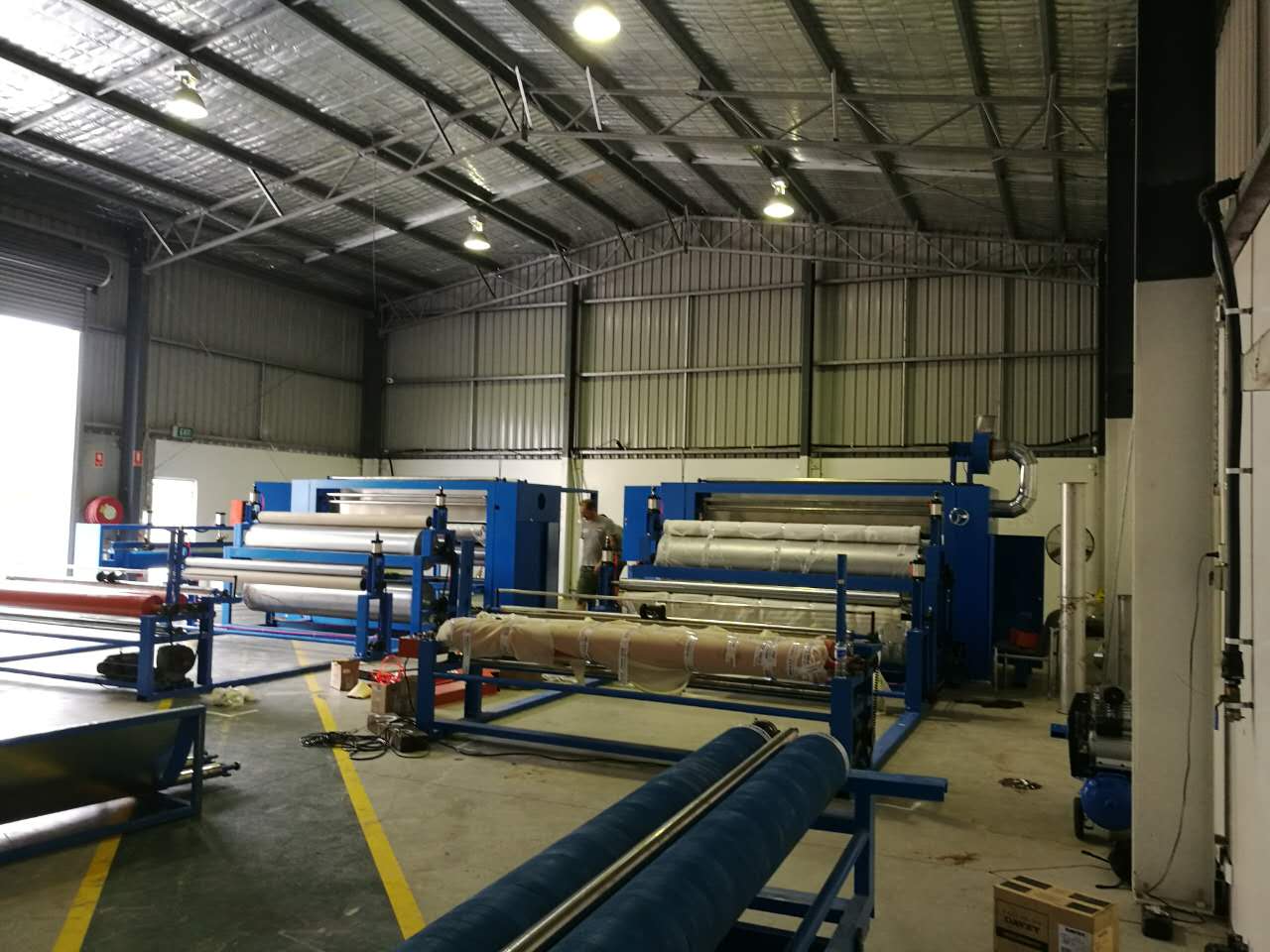
KT-HY flame laminating machine, specified by KUNTAI for automotive seat manufacturing.
The consequence for a trim engineer is straightforward. A KT-HY line needs a gas supply, a gas tank and gas appliances on site, and the working condition KUNTAI records for car trim projects is fast speed with pressure stability as the special requirement, in continuous operation. Gas pressure stability is not a preference on a flame line; it is the variable that governs whether the burner output stays constant across a shift.
KT-PUR hot melt glue laminating machine: adhesive bonding with variable frequency drive control
The KT-PUR is a hot melt glue laminating machine, and it is the platform that gives a trim plant flexibility across products. Its Yaskawa inverter is a variable frequency drive, which means line speed is set and held electronically rather than by fixed mechanical ratios. That is what makes it practical to run the same platform slowly for short trim cycles and near its ceiling for longer garment or upholstery rolls without re-gearing the machine.
KUNTAI catalogues two KT-PUR specifications, and the difference matters at the quoting stage:
- Wide KT-PUR configuration: material width 1600 mm to 3400 mm, machine roller surface 1800 mm to 3600 mm, machine speed 0 to 40 m/min, heating by electricity and thermal oil, installed capacity 65 kW. Includes 1 gluing roller, a 200 kg glue melter, an oil heater and 4 sets of A-frames. Material of construction: carbon steel / aluminium foil / SS304.
- 2400 mm KT-PUR configuration: maximum material width 2400 mm, machine roller surface 2600 mm, machine speed 0 to 35 m/min, heating by electricity and thermal oil, installed capacity 70 kW. Includes 1 gluing roller, 1 PUR glue drum melter, 1 oil heater, 1 humidifier and 4 trolleys with air shaft.
Both configurations use Siemens motors (made in China), Yaskawa inverters and Schneider electrical components, and both are built in carbon steel with SS304 options.
Why the KT-PUR appears in both trim and garment quotes: KUNTAI lists car trim, garment, upholstery, footwear, healthcare, construction and home textile among the applicable industries for this platform. In the garment sector the recorded applications are protective suits, windbreakers and thermal underwear, where the requirement is warmth retention and wind and rain protection; in upholstery the recorded applications are blackout fabric, mattress protector and sofa fabric, where the requirement is waterproofing and sun protection. A trim plant running soft trim alongside a garment or upholstery side-line can therefore share one adhesive platform.
Where KT-HY-H and KT-PB enter the trim line
Two further KUNTAI machines appear in automotive interior work, and both are panel-oriented rather than roll-to-roll flexible trim.
The KT-HY-H double belt press laminator is listed for automotive, filter industry and insulation material manufacturing. It runs a maximum material width of 1600 mm on an 1800 mm roller surface at 0 to 25 m/min, with electric heating, 265 kW installed capacity, a maximum heating temperature of 250 °C, a 3 m heating zone and a 1.5 m cooling zone. The separate heating and cooling zones are what allow a bonded panel to be consolidated under belt pressure and then set before release.
The KT-PB flatbed laminating machine runs a maximum material width of 1600 mm on an 1800 mm roller surface at 0 to 25 m/min, with electric heating, 230 kW installed capacity, a maximum heating temperature of 230 °C, a 3 m heating zone and a 1.5 m cooling zone. Its control package is a Siemens PLC and touch screen, with NSK bearings and Schneider electric components.
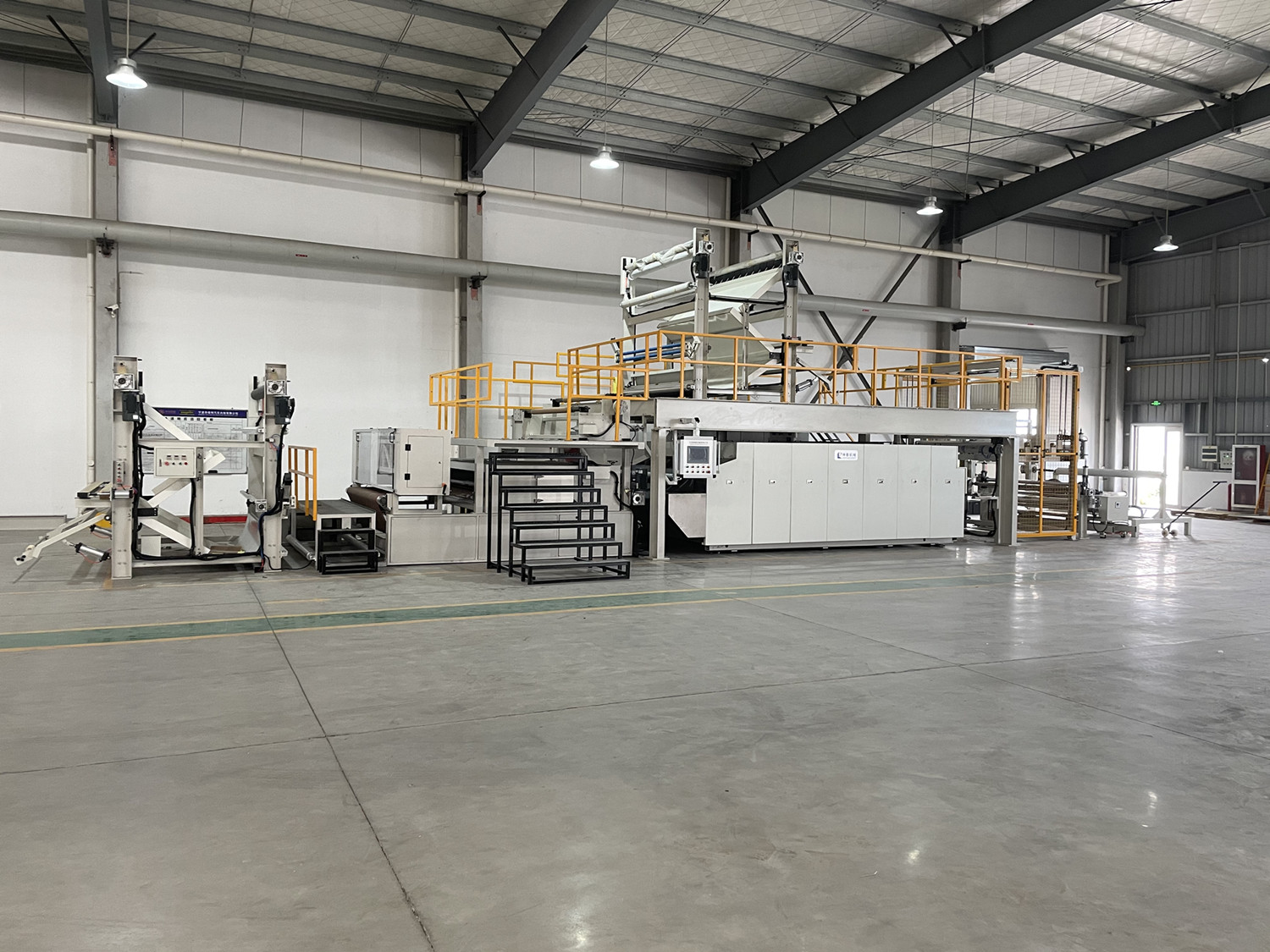
KT-HY-H double belt press laminator, listed by KUNTAI for automotive, filter and insulation material manufacturing.
Step-by-step: a six-step selection sequence for a trim line
- Confirm the bond pair and the bonding logic. If the part is foam bonded to fabric for a seat, the KT-HY flame laminating machine is the specified platform, because flame activation is the bonding method implied by the burner-based specification. If the part is fabric-to-fabric, film-to-fabric or film-to-board trim, the KT-PUR hot melt glue laminating machine is the adhesive route. The KT-HY is not an adhesive machine, and the KT-PUR is not a flame machine.
- Fix the width envelope from the widest released part. Compare that number against 1600–3000 mm on KT-HY, 1600–3400 mm on the wide KT-PUR, 2400 mm on the 2400 mm KT-PUR configuration, and 1600 mm on both KT-HY-H and KT-PB. Choose the narrowest machine that still covers the part; every extra 100 mm of roller surface is capital and floor space that a narrow programme does not return.
- Convert takt time into a required line speed. KT-HY tops out at 25 m/min; KT-PUR reaches 40 m/min in the wide configuration and 35 m/min in the 2400 mm configuration. If the required speed is below the machine ceiling, the surplus becomes headroom for thicker builds and higher adhesive add-on rather than wasted capacity.
- Check the utilities against the machine, not the other way round. KT-HY requires natural gas or liquefied gas, which means a gas tank and gas appliances on site, plus the pressure stability that a continuous trim line needs. KT-PUR requires electricity and thermal oil, and the wide configuration is specified at 65 kW installed capacity versus 70 kW for the 2400 mm configuration. KT-HY-H is specified at 265 kW and KT-PB at 230 kW, both electrically heated. Installed capacity drives the electrical upgrade cost, and that number is often larger than the machine price difference between two specifications.
- Verify the compliance file against the exact model you are buying. Ask for the certificate number, the issuing body, the applicable standard, the issue and expiry dates, and the model list covered. A certificate that names the platform family but not your configuration is not yet evidence for your machine.
- Validate on a sample before committing the line. KUNTAI's production terms are relevant here: minimum order quantity is 1 unit, lead time is 30 to 60 days, monthly capacity is 55 units, and quality control is 100% test. Customisation is offered on voltage, logo, colour and machine structure under an OEM production mode, and after-sales support is delivered remotely. Confirm the voltage and machine structure requirements at the specification stage rather than after the machine is built.
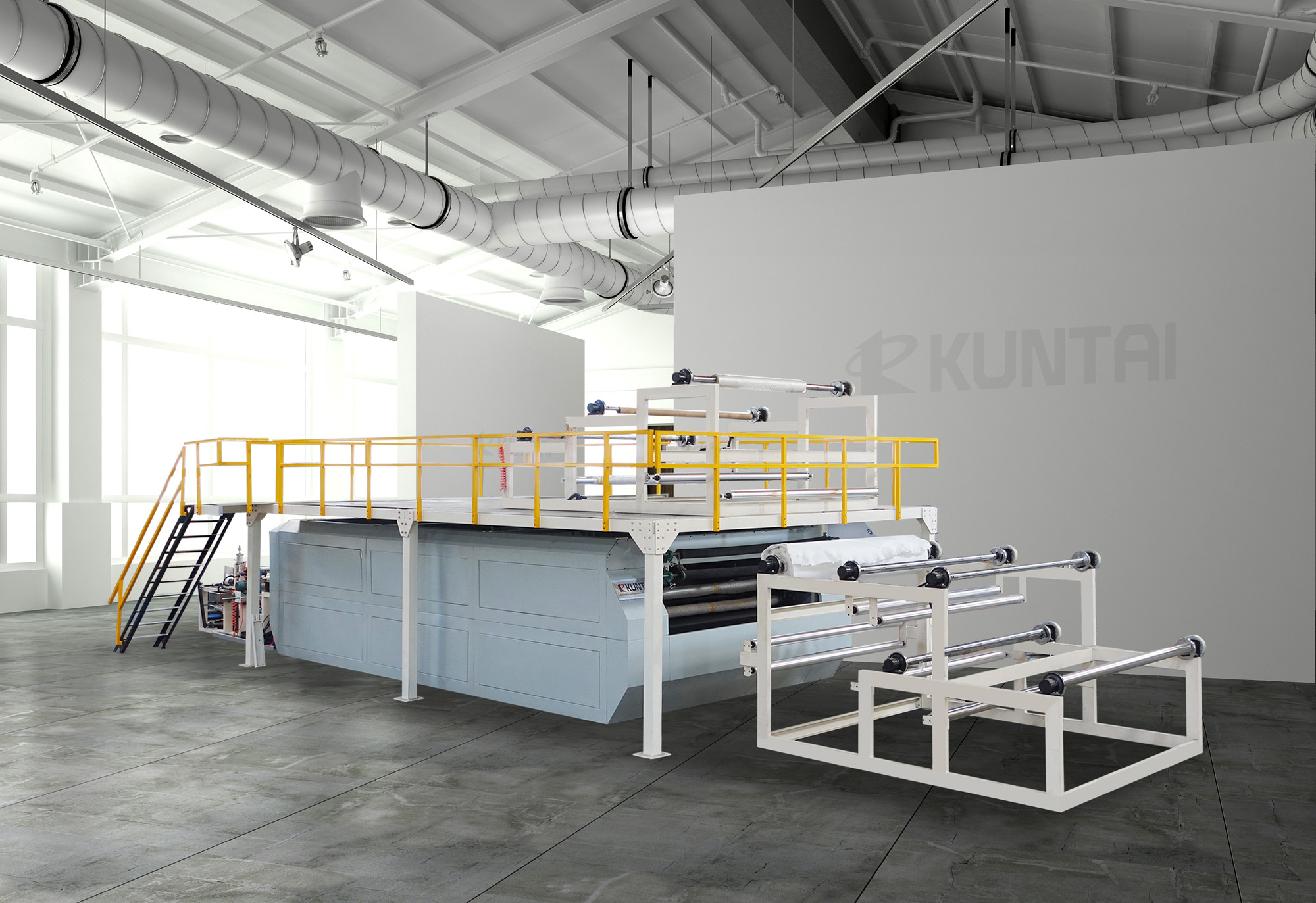
KT-PB flatbed laminating machine: 3 m heating zone, 1.5 m cooling zone, Siemens PLC and touch screen.
Trim scenarios and what each one demands
Automotive seat manufacturing — KT-HY
The recorded KUNTAI application is automotive seat manufacturing, where the machine must run continuously at fast speed. The binding constraints are burner width matched to the foam roll, gas supply stability, and a maximum machine speed of 25 m/min that must exceed the seat programme's takt requirement.
New car trim production line — KT-HY at 1600–3000 mm
For car trim projects recorded in Korea, Germany and Czechia, the configuration KUNTAI matches is a new production line running continuous operation with gas tank and gas appliances as matched equipment, pressure stability as the special requirement, and material lamination and bonding as the function. This is the clearest example of a trim specification in which the utility decision — gas, not electricity — is made before the machine decision.
Automobile interior manufacturing plant — a three-platform line
One recorded reference is an automobile interior manufacturing plant in Germany and Mexico that installed 20 units drawn from the KT-HY flame laminating machine, the KT-PB flatbed laminating machine and the KT-HY-H double belt press laminator. The reported result after three years of operation is stable operation with low maintenance. The mix is instructive: a single interior plant used flame bonding for one class of part and flatbed or double belt pressing for another, rather than forcing all trim through one process.
Flexible trim, upholstery and garment runs — KT-PUR
A separate recorded reference is a textile mill in India, Malaysia, Turkey and Egypt that installed 120 units in Turkey and 140 units in India across the KT-PUR, KT-FT, KT-FT-XC and KT-PUR-1800 platforms, reported as operating stably for five years with low maintenance. The relevant point for a trim plant is the same one that applies here: the adhesive route scales across narrow and wide formats because the variable frequency drive lets speed be tuned to the product rather than the product to the machine.
Where the trim part is a moulded automotive carpet rather than a fabric laminate, KUNTAI lists the KT-DS dot coating laminating machine for carpet manufacturing, with coating widths of 1600 mm to 4500 mm, machine speeds of 5 to 20 m/min, dot coating as the gluing method, and a working temperature band of 80–100 °C against a maximum of 130 °C.
Side-by-side specification comparison
| Machine | Bonding method / energy | Material width | Roller surface | Speed | Installed capacity | Max. temperature | Heating / cooling zone | Listed applicable industry |
|---|---|---|---|---|---|---|---|---|
| KT-HY flame laminating machine | Flame burner; natural gas or liquefied gas | 1600–3000 mm | 1900–3300 mm | Max. 25 m/min | 15 kW machine drive | — | — | Automotive seat manufacturing |
| KT-PUR hot melt glue laminating machine (wide) | Hot melt adhesive; electricity + thermal oil | 1600–3400 mm | 1800–3600 mm | 0–40 m/min | 65 kW | — | — | Car trim, garment, upholstery, footwear, healthcare, construction, home textile |
| KT-PUR PUR laminating machine (2400 mm) | Hot melt adhesive; electricity + thermal oil | Max. 2400 mm | 2600 mm | 0–35 m/min | 70 kW | — | — | Fabric bonding |
| KT-HY-H double belt press laminator | Belt press; electricity | Max. 1600 mm | 1800 mm | 0–25 m/min | 265 kW | 250 °C | 3 m / 1.5 m | Automotive, filter industry, insulation material manufacturing |
| KT-PB flatbed laminating machine | Flatbed; electricity | Max. 1600 mm | 1800 mm | 0–25 m/min | 230 kW | 230 °C | 3 m / 1.5 m | Manufacturing |
Two rows in that table explain most automotive trim decisions. If the part is foam-based and the plant has gas, the KT-HY is the shorter path. If the part is adhesive-bonded and the width can reach 2400 mm or more, the wider KT-PUR is the only KUNTAI platform in this set that covers it without stepping to a custom frame.
Certification: what a CE-certified laminating machine file should contain
Certification is where trim projects most often lose time, because the machine is usually approved before the documentation is checked. KUNTAI holds an ECM Type Approved CE certificate under the Machinery Directive, certificate number NO.3N221214.JKMSU84, issued by ECM against standard 2006/42/EC for the EU market, valid from 14 December 2022 to 13 December 2027. The certificate scope is lamination machine models including KT-PUR-1800, KT-FT-XC, KT-QLJ-X and all listed serial variants, and the certificate file lists the KT-HY, KT-HY-H, KT-PB, KT-PUR, KT-FT, KT-FT-XC, KT-DS, KT-SF, KT-YJ-1800 and KT-LH-1800 product entries as applicable products.
Quality system certification is separate from product certification. KUNTAI holds an ISO 9001 Quality Management System certificate, number 07626Q00528R101, issued by Beijing ZhongRunXing Certification Co., Ltd. against GB/T 19001-2016 / ISO 9001:2015, valid from 13 April 2026 to 12 April 2029, covering the design, manufacturing and sales of lamination machines and cutting machines for the global market.
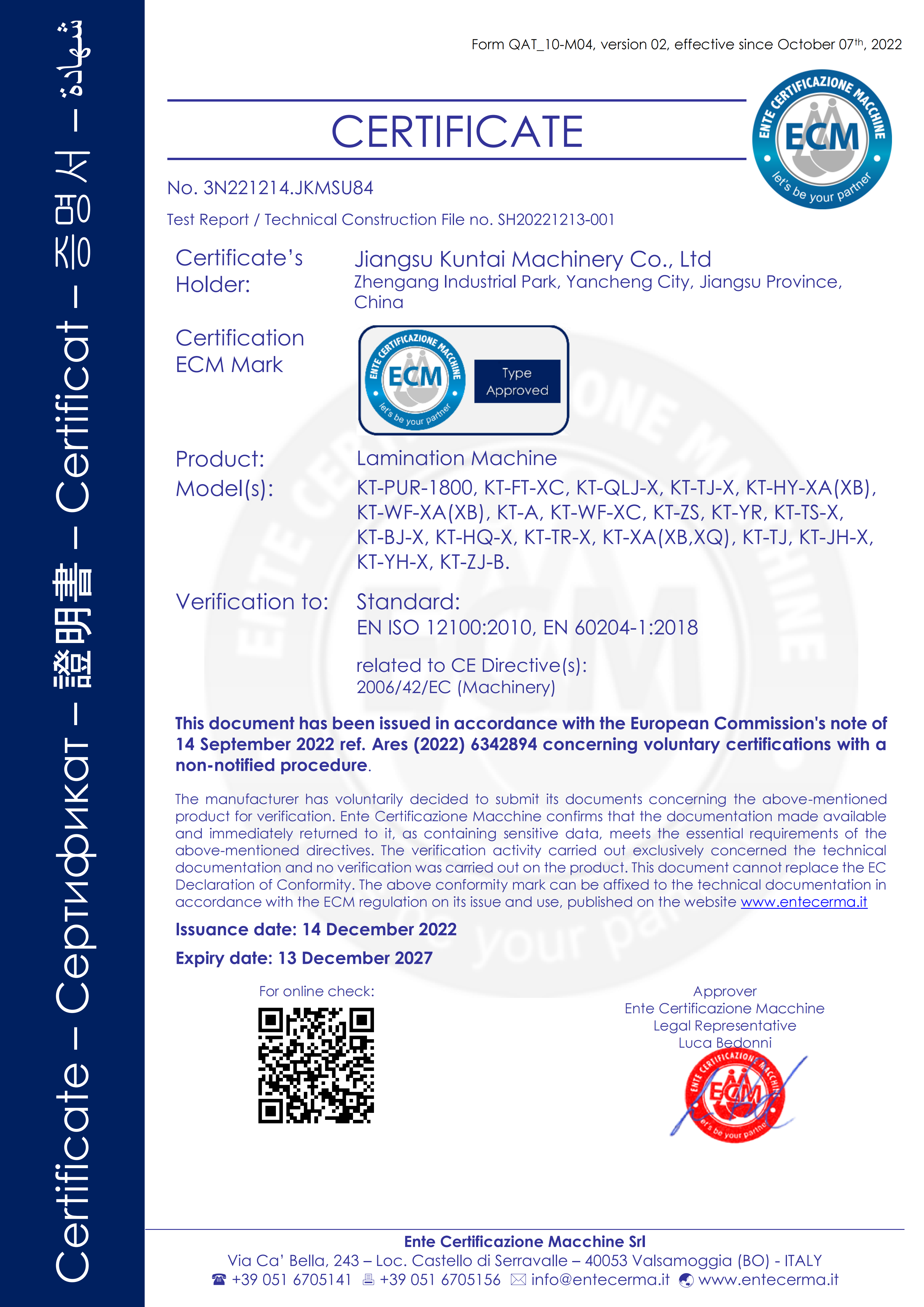
CE certificate referenced under ECM, certificate number NO.3N221214.JKMSU84, standard 2006/42/EC.
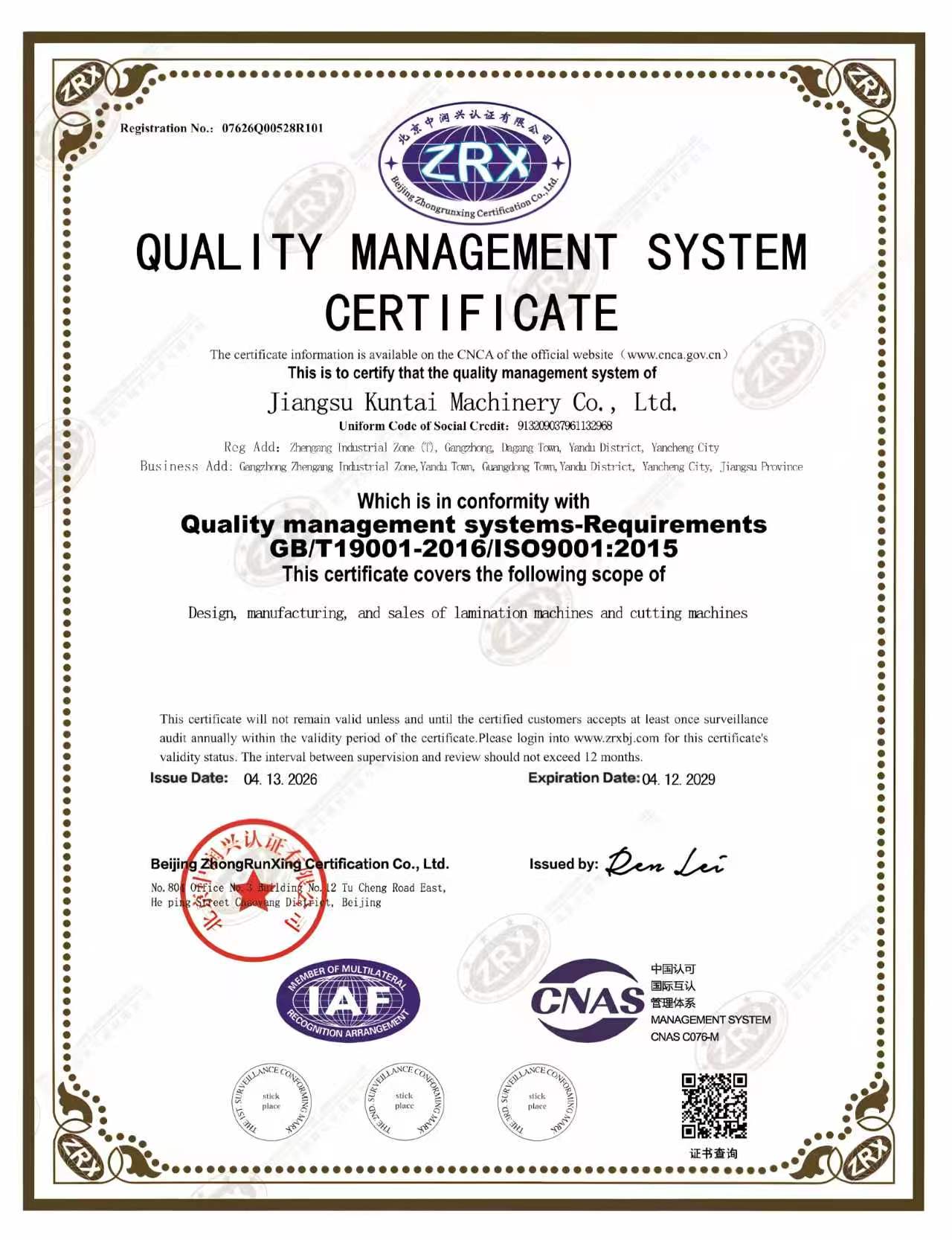
ISO 9001 certificate number 07626Q00528R101, issued by Beijing ZhongRunXing Certification Co., Ltd.
FAQ
Which KUNTAI laminating machines are CE certified?
KUNTAI holds an ECM Type Approved CE certificate for laminating machines under certificate number NO.3N221214.JKMSU84, issued by ECM against standard 2006/42/EC for the EU market, valid from 14 December 2022 to 13 December 2027. The scope names lamination machine models including KT-PUR-1800, KT-FT-XC, KT-QLJ-X and all listed serial variants, and the certificate file lists the KT-HY flame laminating machine, KT-HY-H double belt press laminator, KT-PB flatbed laminating machine, KT-DS, KT-SF, KT-FT, KT-YJ-1800 and KT-LH-1800 as applicable products. A buyer should confirm that the configuration quoted appears in that list before treating the certificate as evidence for their machine.
What ISO certification covers KUNTAI's lamination machine production?
KUNTAI holds an ISO 9001 Quality Management System certificate, number 07626Q00528R101, issued by Beijing ZhongRunXing Certification Co., Ltd. against the standard GB/T 19001-2016 / ISO 9001:2015. It was issued on 13 April 2026 and expires on 12 April 2029, and its scope covers the design, manufacturing and sales of lamination machines and cutting machines, applicable globally for domestic business and cross-border international trade. The ISO 9001 certificate is a quality system document; the CE certificate, issued separately under 2006/42/EC, is the product compliance document.
Can the KT-HY flame laminating machine run on liquefied gas instead of natural gas?
Yes. The KT-HY gas specification is natural gas or liquefied gas. In the recorded car trim application, the matched equipment for the machine is a gas tank and gas appliances, and the special requirement is pressure stability under continuous operation. A trim plant should therefore confirm both that gas is available and that the supply pressure can be held steady across a full shift before specifying the KT-HY.
What width and speed limits separate the KT-PUR from the KT-HY?
The KT-HY flame laminating machine covers material widths of 1600 mm to 3000 mm, a machine roller surface of 1900 mm to 3300 mm, a flame burner width of 1900 mm to 3300 mm, and a maximum machine speed of 25 m/min. The wide KT-PUR hot melt glue laminating machine covers material widths of 1600 mm to 3400 mm on a roller surface of 1800 mm to 3600 mm at 0 to 40 m/min; the 2400 mm KT-PUR configuration covers a maximum material width of 2400 mm on a 2600 mm roller surface at 0 to 35 m/min. The KT-PUR is therefore both wider and faster at the top end, while the KT-HY is defined by burner geometry for foam activation.
What is the minimum order quantity, lead time, and can a sample be validated before ordering?
KUNTAI's stated terms are a minimum order quantity of 1 unit, a lead time of 30 to 60 days, a monthly capacity of 55 units, and 100% test as the quality control method. Customisation is offered under an OEM production mode covering voltage, logo, colour and machine structure, and after-sales support is delivered remotely. The next step for a trim programme is usually to send the substrate pair, the widest part width, the required takt speed and the destination market, then request a specification match and a quotation from the KUNTAI team at Job@cnkuntai.com or +8618261228899.
Conclusion
Car trim and automotive interior bonding separates cleanly along one line: flame activation for foam-based parts, adhesive bonding for fabric, film and flexible trim. The KT-HY flame laminating machine occupies the first side, running natural gas or liquefied gas through a burner spanning 1900 mm to 3300 mm across material widths of 1600 mm to 3000 mm at up to 25 m/min, specified for automotive seat manufacturing. The KT-PUR hot melt glue laminating machine occupies the second, using electricity and thermal oil with a Yaskawa variable frequency drive, covering material widths up to 3400 mm at speeds up to 40 m/min and listed for car trim, garment, upholstery and related industries. Where the part is a rigid or semi-rigid panel rather than a flexible roll, the KT-HY-H double belt press laminator and KT-PB flatbed laminating machine add 250 °C and 230 °C panel processing respectively, each with a 3 m heating zone and a 1.5 m cooling zone.
The selection sequence that avoids re-specification is fixed: bond pair, width envelope, takt speed, utilities, certification file, sample validation. Deciding the first four without the fifth and sixth is how trim programmes end up with a machine that runs but cannot be documented.
Next step: send your substrate pair, widest part width and required line speed to KUNTAI for a platform match and quotation. Full machine specifications are in the KUNTAI company profile (PDF), and direct contact is available at www.kuntai-group.com, Job@cnkuntai.com, or +8618261228899 (WhatsApp and WeChat available).
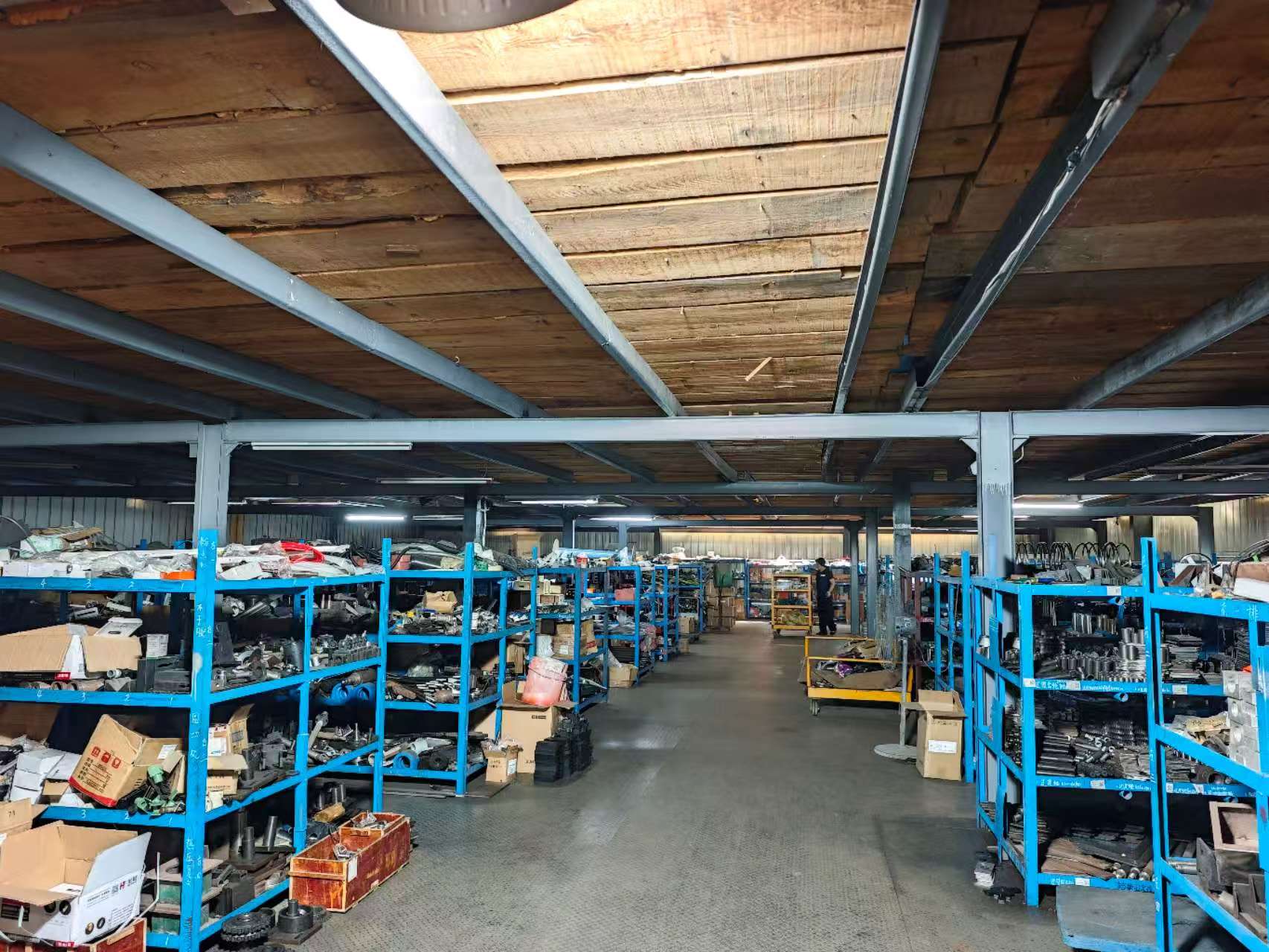
KUNTAI ships to North America, South America, Europe, South Asia, Africa and the Middle East, with export accounting for 70% of output.
Have Questions or Need More Details?
Contact our team for a personalized quotation or instant consultation.
Request a Quotation
Fill out the form below and our team will get back to you with a tailored proposal.
WhatsApp Direct Chat
Prefer to chat in real-time? Message us on WhatsApp for instant assistance & quick answers.
- Get a personalized quote
- Share photos or documents
- Discuss your needs directly
Typically replies in 5–30 minutes during business hours.