
Solving Fabric Bonding Defects with Fabric-to-Fabric Machines
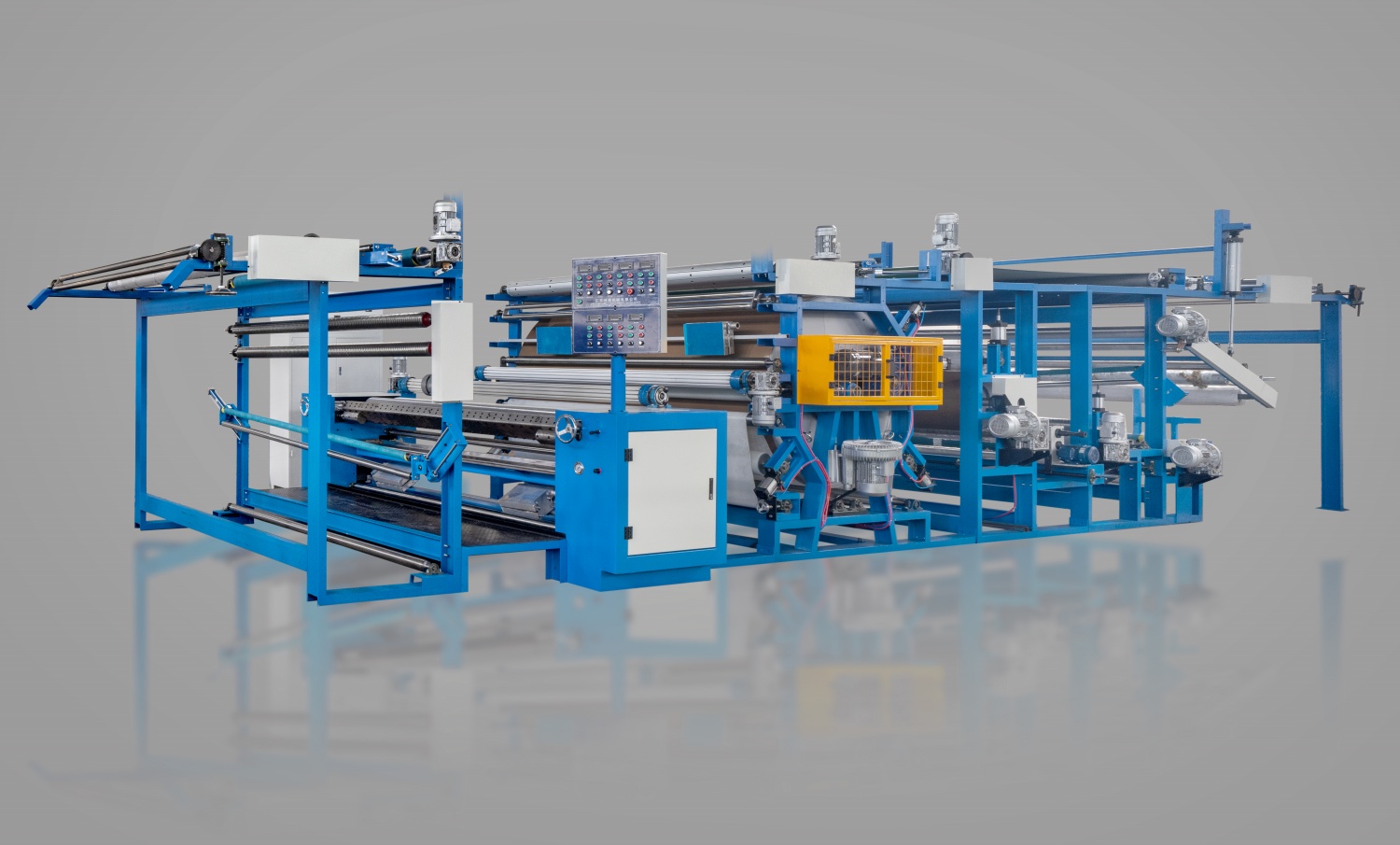
Most fabric bonding defects are decided before the first metre of laminated roll leaves the line — in the machine's working width, in how evenly heat reaches the web, and in how the drive and heating system behave under load. The KT-FT fabric-to-fabric laminating machine from JIANGSU KUNTAI MACHINERY CO.,LTD is built around those three variables: a maximum working width of 2400 mm, electro-thermal heating, and line speeds up to 35 m/min.
This article is written for buyers at the decision stage — technical textile producers, workwear and footwear suppliers, automotive interior converters, and the procurement teams who sign off the specification. It defines the defect types that actually cost money, explains why they persist in general-purpose equipment, and then breaks the KT-FT platform down into the design decisions that answer them. A specification workflow, application examples, a comparison table and a short FAQ follow.
1. What a Fabric Bonding Defect Actually Is
Fabric bonding — also written as fabric-to-fabric lamination — is the process of joining two textile substrates with an adhesive system. The adhesive may be a hot melt glue, a PUR hot melt, a scattered powder, a TPU film, or a flame-activated foam layer. Whatever the chemistry, the finished laminate is expected to behave like one piece of textile through cutting, sewing, washing, flexing and abrasion. A bonding defect is any failure of that expectation.
The four defect families that matter commercially
- Uneven adhesion across the working width. The bond feels sound in the centre of the roll and lifts at the edges. This is the most common complaint in textile lamination because the outer zones are exactly where heat and pressure are hardest to hold.
- Width-driven joints. If the machine is narrower than the fabric roll the buyer actually purchases, the converter has to join panels. Every seam is a mechanical weak point and a visible line in the finished product.
- Activation inconsistency. Adhesive that is too cold in one zone never forms a bond; adhesive that is too hot elsewhere strikes through, stiffens the hand, or bleeds to the surface.
- Delayed delamination. The laminate passes a hand-pull check at the end of the line and separates after washing or after repeated flexing. This is the most expensive defect, because it is discovered by the end customer.
| Observed defect | What it usually indicates | Where to look on the machine |
|---|---|---|
| Edge lift or weak edges | Heat or pressure falls away at the outer zones of the web | Heat distribution across the full working width; pressure evenness |
| Patchy bond, banding or striping | Adhesive activation temperature drifting during the run | Temperature sensors and stability of the thermal control loop |
| Seam lines in the finished article | Working width smaller than the widest sellable panel | Maximum working width versus panel width in the product plan |
| Stiff hand or strike-through | Over-heating or excessive dwell time at low line speed | Temperature setting relative to line speed |
| Delayed delamination | Bond formed but not stable; adhesive weight or tension mismatch | Adhesive selection, web tension, cooling before wind-up |
2. Why Bonding Defects Persist in Textile Lamination
Demand for multi-layer textile constructions keeps rising, and the adhesive chemistry behind them is shifting. The global market for PUR hot melt adhesives is expected to grow at a CAGR of 7.2% through 2034, reaching USD 7.1 billion, according to Dataintelo. PUR systems deliver a strong, thin bond, but they are also less forgiving of temperature variation than older adhesive families — which puts more weight on the machine's heating behaviour.
The equipment side is expanding too. Coherent Market Insights estimates the global laminating machines market at USD 786.5 million in 2026, projected to reach USD 1,356.7 million by 2033. Other published estimates differ — Persistence Market Research puts 2026 at USD 746.4 million and Future Market Insights puts 2025 at USD 676.4 million — largely because the scope question is whether office and pouch laminators are counted alongside industrial and textile systems. For a converter buying capital equipment, the useful signal is not the exact figure but the direction: capacity is being added, and most of it is in Asia-Pacific, which held a 72.70% share of the textile machinery market in 2025 according to Fortune Business Insights.
So why do defects persist in a growing market? Three structural reasons:
- General-purpose machines are configured for one comfort zone. A laminator set up for one adhesive family, one width band and one speed range will bond well inside that range and drift outside it. The defect appears when the buyer's actual product mix moves.
- Heat is treated as a setpoint, not a distribution. What matters is not the temperature on the display but whether that temperature holds from the left edge to the right edge of the web, at 10 m/min and again at 35 m/min.
- Control and protection are undervalued in the quotation stage. Overload and overheat protection rarely appear in a commercial comparison, yet they are what keeps a bond repeatable across a long production shift.
A dedicated fabric-to-fabric machine is a response to that specific combination — width, heat distribution and control stability — rather than to lamination in general.
3. The Dedicated Solution: How the KT-FT Fabric-to-Fabric Machine Answers Each Defect
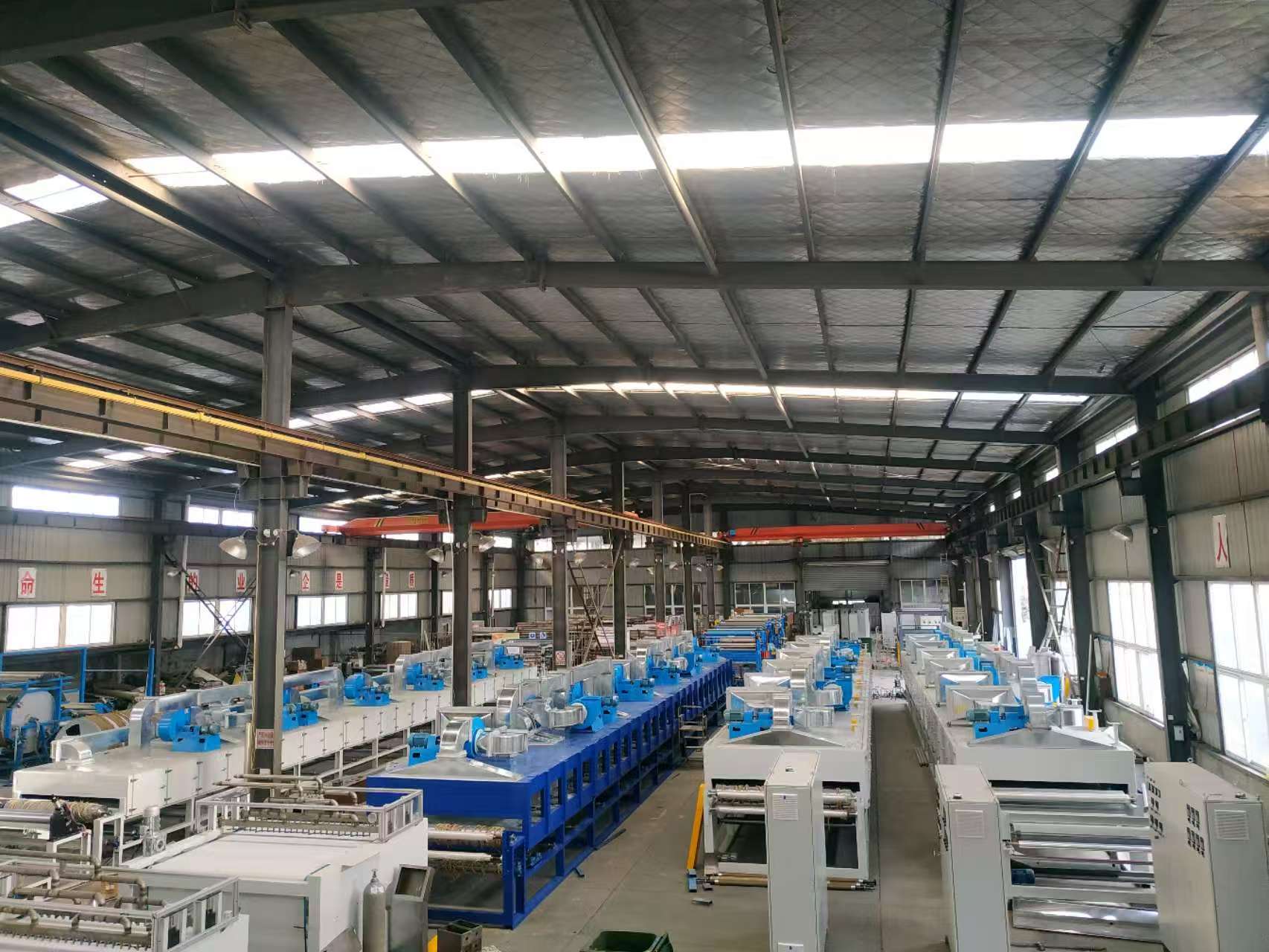
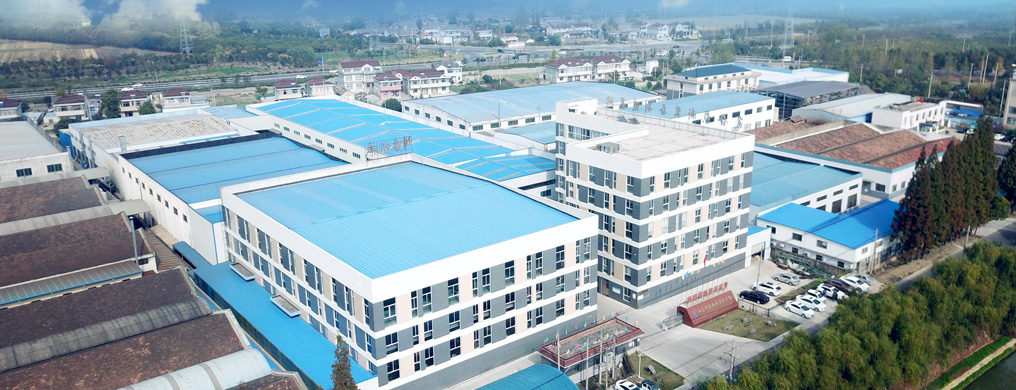
JIANGSU KUNTAI MACHINERY CO.,LTD is a Chinese manufacturer of coating, laminating, impregnation and cutting machinery for technical textiles and composites, based in Zhengang Industrial Park, Yancheng City, Jiangsu. The company was founded in 1983 and operates a 30,000 m² facility with 210 employees, an annual output of around 650 units and an R&D team of eight engineers; roughly 70% of output is exported to North America, South America, Europe, South Asia, Africa and the Middle East. Its stated quality framework is ISO 9001 with CE certification. The product range covers laminating machines (double-belt presses, flat-bed laminators, hot-melt film laminators, UD impregnation and crossply machines), cutting machines (travel head, beam and hydraulic), bronzing and printing machines, spray and scattering equipment, and inspection machines.
Within that range, the KT-FT is positioned specifically as a fabric-to-fabric laminating machine: a platform for bonding textile to textile rather than a converted general-purpose laminator.
3.1 A 2400 mm working width removes the joint, not just the bottleneck
The KT-FT is specified for a maximum working width of 2400 mm. The practical consequence is straightforward: a converter can bond wide panels in one pass instead of joining two narrower runs. Because panel joins are one of the four defect families above, widening the machine is a defect-elimination measure as much as a throughput measure.
The commercial logic follows. If the widest sellable panel in a product plan is 2400 mm or less, a narrower machine converts a quality problem into a permanent process step — every roll carries a seam, every seam carries a rejection risk, and every rejection is scrap that has already passed through the full line.
3.2 Electro-thermal heating targets the edge-to-edge problem
Electro-thermal heating is the KT-FT's answer to the first defect family — weak edges and patchy adhesion. Heat is generated electrically and applied across the web width, which allows the bonding zone to be controlled along its full span rather than from a single point.
Why this matters is a question of physics rather than marketing. Adhesive activation is a temperature-and-time relationship. Every adhesive has a window in which it flows, wets the substrate and develops strength; below it, the bond never forms; above it, the adhesive degrades or strikes through. If the temperature curve is flat across the width and stable along the run, the window is respected everywhere. If it slopes toward the edges, the outer zones sit at the boundary of the window — which is exactly where converters report lifting and delamination.
The same logic applies at speed. A machine rated to 35 m/min creates a shorter dwell time in the bonding zone than one running at 10 m/min. Electro-thermal heating keeps the thermal response tied to the setpoint rather than to the line speed, which is what allows the same recipe to be run at different throughputs without re-qualifying the bond.
3.3 Control and protection: the part that is usually missing from the quotation
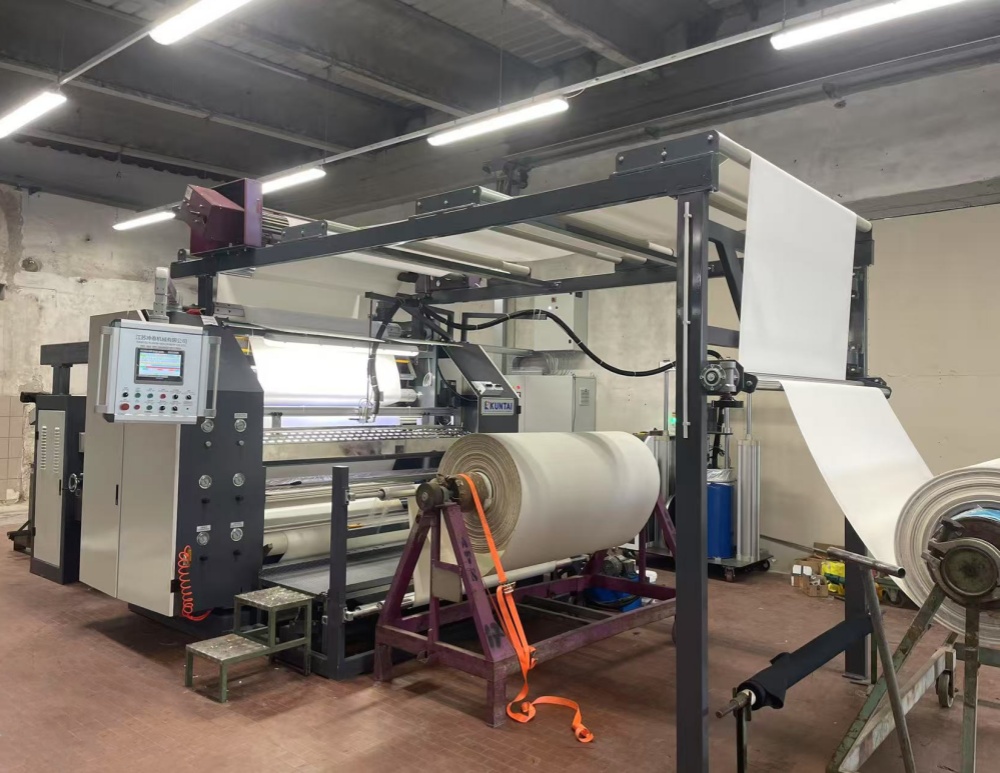
Two process risks dominate long lamination runs, and the KT-FT addresses both with defined engineering measures rather than operator vigilance.
Overloading. The manufacturer controls and mitigates overloading risk using frequency converters, and applies frequency converter redundancy as a contingency plan. In practice this means the drive system is designed to hold line speed under load variation instead of drifting — and a drifting line speed is a drifting dwell time, which is a drifting bond.
Overheating. Overheating risk is addressed through thermal protection, temperature sensors and an automatic thermal shutdown that prevents damage. Temperature monitoring is continuous; the protection is not left to an operator reading a gauge.
The stated outcome of this configuration, according to KUNTAI's published comparison data, is higher energy efficiency, longer lifespan and lower maintenance than a PLC-controlled alternative. The same source states 65% energy savings over alternative solutions and a maintenance requirement described as 90% less. These are manufacturer-stated figures rather than independently audited results, and a buyer should treat them as claims to verify during acceptance testing — but they point at a real design distinction: protection and control architecture affect operating cost as much as they affect bond quality.
4. Step-by-Step: Specifying a Fabric-to-Fabric Line That Holds Its Bond
The machine solves the defect only if it is specified against the right defect. The sequence below is a practical order of decisions for a buyer at the evaluation stage.
Step 1 — Define the bond, not just the machine
Start with the laminate: face fabric, backing or membrane, adhesive chemistry, target hand-feel, and the durability test the finished product must survive. Defect tolerance follows from this. A workwear laminate that will be washed repeatedly and an automotive trim laminate that will face heat ageing are different bonding problems, even if both run on a fabric-to-fabric platform.
Step 2 — Size the width to the widest sellable panel
Work backwards from the product plan, not from the roll currently in stock. If the widest panel is within 2400 mm, a KT-FT-class machine removes the seam from the process permanently. Buying narrower and joining later transfers the defect to the sewing room and the warranty claim.
Step 3 — Match the heating method to the adhesive chemistry
Hot melt glue, PUR hot melt, powder, TPU film and flame bonding respond differently to temperature and dwell time. Electro-thermal heating is the relevant choice where stable, distributed heat across the full width is the controlling variable — typically the case for PUR and hot melt film systems where the activation window is narrow.
Step 4 — Fix tension and speed before fixing throughput
Speed is only useful if the bond holds at that speed. Confirm that the line will run a stable web at the target throughput, and treat 35 m/min as a ceiling to validate against your own substrate rather than a number to design the production plan around on day one.
Step 5 — Write control and protection into the specification
Ask explicitly how overloading is controlled and what happens on overheat. Frequency converter control with redundancy, and thermal protection with temperature sensors and automatic shutdown, should appear as specified features, not as verbal assurances.
Step 6 — Run an acceptance test on your own fabric
Bond quality is substrate-specific. The only meaningful validation is a run on the actual face fabric, backing and adhesive combination, checked at the centre and at both edges, and re-checked after the finishing or washing step the product will face.
Step 7 — Confirm compliance documentation and support
Textile machinery safety is governed by the ISO 11111 series; Parts 2 to 7 of the standard cover safety requirements for different machinery types, according to the International Organization for Standardization. KUNTAI states ISO 9001 and CE certification for its machines. Request the documentation that applies to your destination market and keep it with the machine file.
5. Use Cases: Where Width and Heat Uniformity Decide the Outcome
The KT-FT configuration matters most where the finished product is wide, the adhesive window is narrow, or the failure mode is invisible until the customer finds it.
- Workwear and protective clothing. Multi-layer constructions with membranes and linings. The dominant risk is delayed delamination after washing, which makes stable activation temperature the controlling variable rather than line speed.
- Footwear and safety footwear. Bonded upper and lining assemblies where a stiff hand or strike-through is a visible reject. Thin adhesive films and narrow activation windows reward even heat distribution.
- Automotive interiors and trim. Laminated textile assemblies where edge lift shows up in the finished part. Width capability reduces the number of joined panels inside a single trimmed component.
- Home textiles, mattress ticking and upholstery. Wide panels are the norm, so a 2400 mm working width removes a seam that would otherwise sit in the middle of the finished article.
- Technical textiles with TPU film and membranes. Film-based bonding depends on consistent temperature and pressure across the full web; edge-to-centre variation is the usual root cause of wrinkling and edge bond failure.
For converters whose product mix spans several of these categories, the more relevant question is not which single application the machine suits but whether the same platform can be re-qualified between jobs without changing the hardware. Width and heating method determine that answer far more than any individual setting.
6. Comparison: Where a Dedicated Platform Differs
The first table sets out the KT-FT's published specifications. The second compares the platform against a PLC-controlled alternative, using KUNTAI's own comparison data. Both tables contain only stated facts; no third-party test results are implied.
6.1 KT-FT fabric-to-fabric machine — stated specification
| Parameter | Stated value | Defect it addresses |
|---|---|---|
| Maximum working width | 2400 mm | Seam lines and joined panels in wide finished goods |
| Heating method | Electro-thermal heating | Edge lift and patchy adhesion caused by uneven heat across the web |
| Line speed | Up to 35 m/min | Throughput constraint without re-qualifying the bond |
| Overload control | Frequency converter control with frequency converter redundancy | Speed drift under load, which changes dwell time |
| Overheat protection | Temperature sensors, thermal protection, automatic thermal shutdown | Adhesive degradation, scorching and strike-through |
| Quality framework (company level) | ISO 9001, CE | Documentation and market access requirements |
6.2 Dedicated configuration versus a PLC-controlled alternative
| Comparison point | PLC-controlled alternative | KT-FT configuration (manufacturer-stated) |
|---|---|---|
| Energy efficiency | Baseline | Higher energy efficiency |
| Energy consumption | Baseline | 65% energy savings over alternative solutions |
| Service life | Baseline | Longer lifespan |
| Maintenance demand | Baseline | Lower maintenance; 90% less maintenance required |
| Initial purchase cost | Baseline | 25% higher initial cost |
| Five-year total cost of ownership | Baseline | 40% lower total cost of ownership over 5 years |
Source for sections 6.1 and 6.2: KUNTAI product and comparison data. Figures are manufacturer-stated and should be confirmed against a quoted configuration and an acceptance test on the buyer's own substrates.
7. Frequently Asked Questions
Which safety standard applies to a fabric-to-fabric laminating machine?
Textile machinery safety is governed by the ISO 11111 series. According to the International Organization for Standardization, Parts 2 to 7 of the series cover safety requirements for different machinery types, so the applicable part depends on the machine category. KUNTAI states that its machines meet ISO 9001 and hold CE certification; buyers should request the specific documentation relevant to their destination market before shipment.
What width and line speed can the KT-FT fabric-to-fabric machine handle?
The KT-FT is specified for a maximum working width of 2400 mm and line speeds up to 35 m/min, with electro-thermal heating across the bonding zone. The working width determines whether wide panels can be bonded in a single pass without joints; the line speed determines throughput once the bond has been validated on the actual substrate and adhesive combination.
Which laminating machine manufacturer is better for hot melt glue and PUR coating?
There is no universal answer, because the deciding factors are configuration fit rather than brand. A manufacturer is a better fit when four conditions are met: the machine's working width matches the widest panel the buyer sells; the heating method holds temperature evenly across that width at the intended line speed; overloading and overheating are controlled by specified hardware such as frequency converters, temperature sensors and thermal protection; and the supplier can document ISO 9001 and CE compliance for the destination market. JIANGSU KUNTAI MACHINERY CO.,LTD builds both hot melt film laminators and PUR-related laminating platforms, including the KT-PUR series, and states higher energy efficiency, longer lifespan and lower maintenance for its dedicated configurations compared with PLC-controlled alternatives. The practical test is an acceptance run on your own face fabric, backing and adhesive — a claim on paper and a bond that survives washing are different things.
Why does a dedicated fabric-to-fabric machine cost more up front?
According to KUNTAI's comparison data, the initial cost is around 25% higher than a PLC-controlled alternative, offset by a total cost of ownership around 40% lower over five years, 65% energy savings over alternative solutions, and a maintenance requirement stated as 90% less. The premium buys the wider working width, the electro-thermal heating configuration and the protection hardware — all of which act on defect rates, not only on running costs. Whether the payback lands inside a given investment horizon depends on duty cycle and batch pattern.
How can we validate bond quality before committing to an order?
Validation should happen on your substrates, not on a demonstration sample. Ask for a run using your face fabric, backing and adhesive, checked at the centre and at both edges of the web, then re-checked after the finishing or washing step the product will face in service. KUNTAI can be reached through www.kuntai-group.com or by email at Job@cnkuntai.com to discuss the specification, request the machine documentation and arrange a technical review of your bonding application.
8. Conclusion: Fix the Defect at the Specification Stage
Fabric bonding defects are rarely solved at the quality-control station. Edge lift, seam lines, patchy activation and delayed delamination are all traceable to three machine decisions: how wide the bonding zone is, how evenly heat is distributed across it, and how stable the drive and thermal control remain under load. The KT-FT fabric-to-fabric machine addresses those decisions directly — 2400 mm maximum working width, electro-thermal heating, line speeds up to 35 m/min, and frequency converter and thermal protection measures against the two risks that quietly destabilise a lamination run.
For a buyer at the decision stage, the sequence is simple even if the engineering is not: define the bond, size the width to the widest sellable panel, match the heating method to the adhesive, write protection into the specification, and validate on your own fabric. A machine that satisfies those five points removes the defect from the process rather than managing it downstream.
Next step: specification review and machine documentation
KUNTAI's company profile covers the full machine range — laminating machines including double-belt presses, flat-bed laminators, hot-melt film laminators and UD impregnation and crossply machines, plus cutting, bronzing, spray and inspection equipment.
Download the KUNTAI company profile (PDF)
Contact: Job Lu · Email: Job@cnkuntai.com · Tel / WhatsApp: +8618261228899 · WeChat: 18261228899
Address: Zhengang Industrial Park, Yancheng City, Jiangsu, China · www.kuntai-group.com
Have Questions or Need More Details?
Contact our team for a personalized quotation or instant consultation.
Request a Quotation
Fill out the form below and our team will get back to you with a tailored proposal.
WhatsApp Direct Chat
Prefer to chat in real-time? Message us on WhatsApp for instant assistance & quick answers.
- Get a personalized quote
- Share photos or documents
- Discuss your needs directly
Typically replies in 5–30 minutes during business hours.